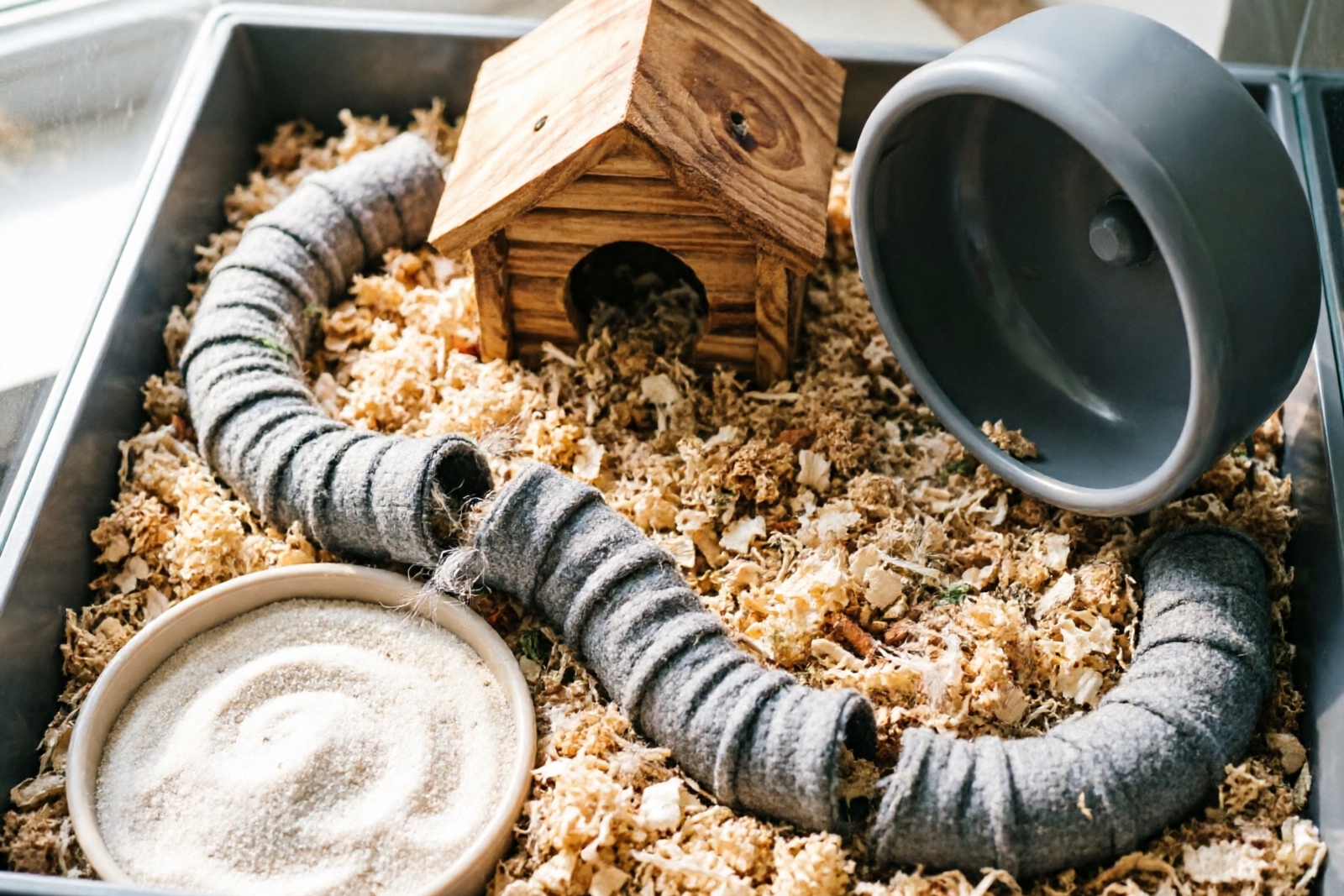
Why Hamster Cage Enrichment Matters
In the wild, hamsters travel up to several miles each night, dig complex burrow systems spanning multiple chambers, and spend hours foraging for scattered food. A typical pet cage — a flat enclosure with a wheel, water bottle, and food bowl — bears almost no resemblance to this rich, stimulating environment. Hamster cage enrichment bridges that gap by recreating the natural challenges and opportunities your hamster instinctively needs.
Without proper enrichment, hamsters develop serious behavioral and health problems. Bar biting, repetitive pacing, excessive cage climbing, and aggression all signal a hamster experiencing chronic stress from an under-stimulating environment. These aren’t just behavioral quirks — they’re welfare issues that can shorten your hamster’s lifespan and significantly reduce their quality of life.
What Happens Without Enrichment
Hamsters deprived of environmental stimulation develop stereotypic behaviors — repetitive, purposeless actions that indicate psychological distress. The most common signs include:
- Bar biting: Chewing cage bars compulsively, often causing dental damage
- Pacing: Walking the same path along cage walls repeatedly
- Cage climbing: Scaling walls and falling repeatedly, risking injury
- Lethargy: Sleeping excessively with little interest in exploring
- Aggression: Becoming irritable or defensive when previously docile
These behaviors typically develop within weeks of living in a barren environment. The good news: they’re largely reversible when proper enrichment is introduced.
The 5 Natural Behaviors to Support
Effective enrichment targets five core natural behaviors that every hamster needs to express:
-
Hiding (Security) — Hamsters are prey animals that need safe, enclosed spaces. Without a proper hideout, chronic stress becomes inevitable. A quality hideout provides the dark, enclosed sleeping quarters that mimic underground burrow chambers.
-
Digging (Instinct) — In the wild, hamsters construct elaborate multi-chamber burrows. Deep bedding (minimum 6-10 inches) allows your hamster to tunnel and create underground spaces. This single enrichment element dramatically improves welfare.
-
Foraging (Mental Stimulation) — Scattering food rather than bowl-feeding transforms every meal into a mental challenge. Puzzle feeders and foraging toys add complexity that keeps your hamster’s mind active and engaged.
-
Climbing (Exercise) — Platforms, ladders, and safe structures provide vertical exploration opportunities beyond the exercise wheel. Natural materials like cork bark and branches work especially well.
-
Cleaning (Natural Hygiene) — Sand baths aren’t optional luxuries; they’re essential for maintaining coat health. Hamsters groom themselves using sand, and without a proper sand bath area, skin and coat problems can develop.
For foundational information on creating the right environment, see our hamster cage setup guide.
What Does a Hamster Need in Its Cage?
Understanding what your hamster needs goes beyond basic supplies like a water bottle and food bowl. An enrichment-focused approach designs the entire cage around behavioral needs, creating distinct zones that support different natural activities.
The 5-Zone Cage Layout
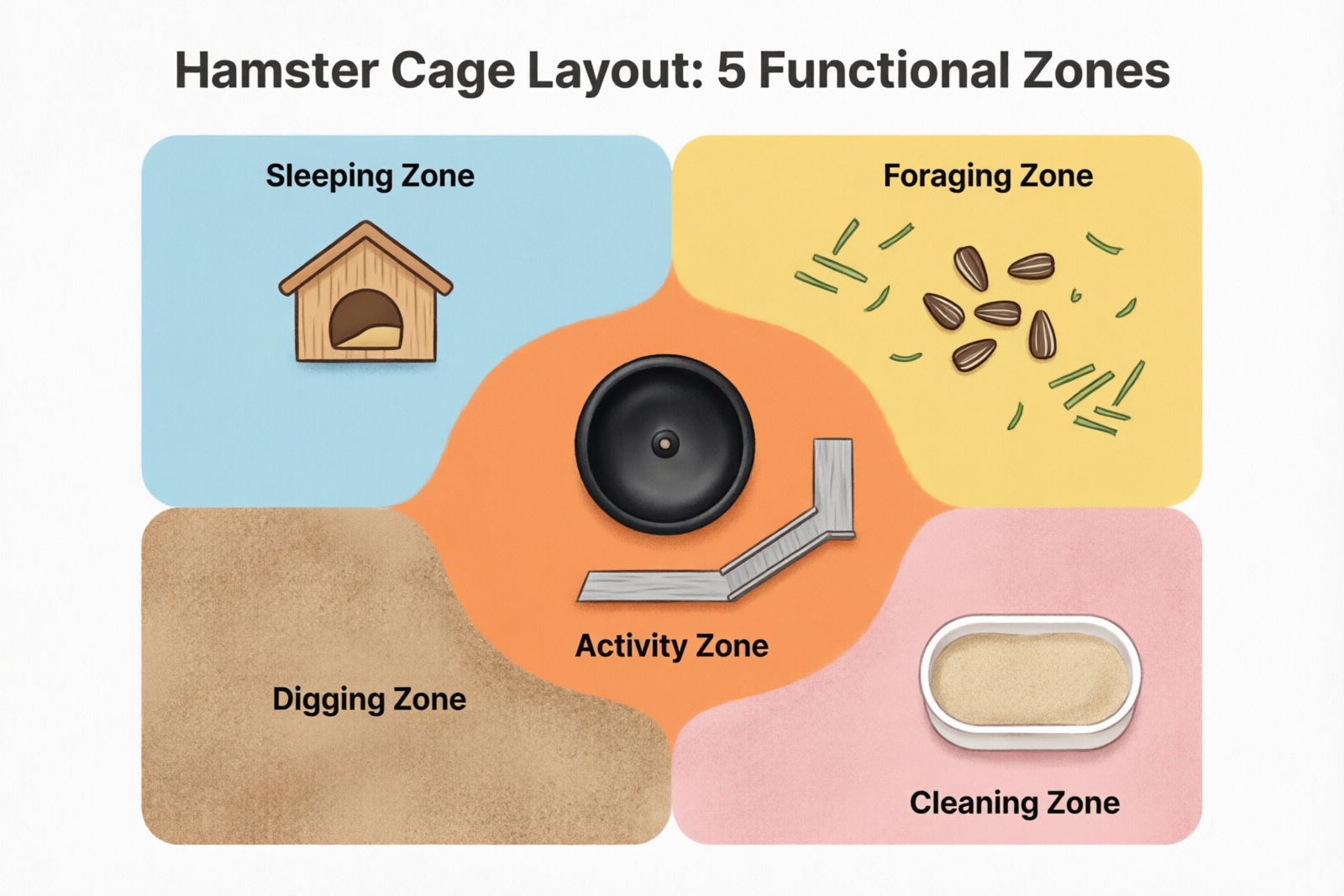
An effectively enriched cage divides space into five functional zones:
Sleeping Zone — A quiet corner containing at least one enclosed hideout. Position this away from the wheel and main traffic areas. Syrian hamsters need hideouts with entrances at least 3 inches wide, while dwarf hamsters can use smaller entrances.
Foraging Zone — Rather than placing food in a single bowl, scatter feeding across this area encourages natural foraging behavior. Include puzzle feeders and treat-hiding spots throughout this zone.
Activity Zone — The exercise wheel goes here, along with climbing structures, platforms, and tunnels. Keep this zone separate from the sleeping area since wheel noise can disrupt rest. For additional exercise options, see our hamster exercise guide.
Digging Zone — This is the largest zone, requiring deep bedding of 6-10 inches or more. Paper-based bedding or aspen shavings work best. This area should occupy roughly 40-50% of the total cage floor space.
Cleaning Zone — A designated sand bath area where your hamster can groom naturally. Position this away from food and sleeping areas to prevent sand contamination.
Common Cage Layout Mistakes
- Food bowl too close to the toilet area — Hamsters instinctively avoid soiling near food. Position these zones on opposite sides of the cage.
- Wheel next to the sleeping hideout — The constant noise and vibration disrupt sleep cycles. Maintain at least 6 inches of separation.
- Bedding too shallow — Less than 6 inches prevents meaningful digging. If your cage can’t hold deep bedding, consider a DIY digging box as a supplement.
- No hideout provided — Without an enclosed sleeping space, hamsters experience chronic stress from feeling exposed. This is non-negotiable for hamster welfare.
For detailed guidance on proper hamster cage setup, including cage size requirements and substrate selection, review our complete setup guide.
Enrichment Products Worth Considering
Choosing enrichment products means selecting items that support specific natural behaviors rather than accumulating random accessories. The four products below represent the most useful options across different behavioral categories, based on real customer reviews and proven effectiveness.
Niteangel Multi-Chamber Hamster House Maze
The Niteangel Multi-Chamber Hamster House Maze ($29.99, 4.7 stars) is the single most impactful enrichment product I’ve used. Its 6-room design satisfies both the hiding instinct and the drive to explore, effectively recreating a simplified burrow system. The maze structure encourages natural tunneling behavior while providing multiple enclosed sleeping and resting chambers.
I’ve recommended this to owners of both Syrian and dwarf hamsters, and it works well for both — though larger Syrian hamsters may find some chambers a snug fit. At $29.99, it’s not cheap, but it addresses two behavioral needs (hiding and exploring) in one product, which I think justifies the cost.
VESPRO Hamster Toys Set
The VESPRO Hamster Toys Set ($13.59, 4.6 stars) includes a swing, seesaw, bridge, and multiple chew pieces made from apple wood and timothy hay. The natural wood materials are safe for chewing and help maintain dental health — hamster teeth never stop growing, so consistent chewing opportunities are essential.
At $13.59, this set delivers good value. I like that it serves multiple purposes: chewing, climbing (the bridge), and swinging (though some hamsters ignore the swing entirely). The natural materials are a plus over plastic alternatives.
Foraging Toys 6-in-1 Puzzle Set
The Foraging Toys 6-in-1 ($8.99, 4.2 stars) provides six different wooden puzzle toys that each require different manipulation to release treats. At $8.99, it’s the most affordable option and works well with your hamster’s regular hamster diet by hiding familiar foods inside.
The slightly lower 4.2-star rating reflects that some designs may be challenging for smaller dwarf hamsters. I’d recommend starting with the simpler puzzles and progressing as your hamster learns. Some hamsters figure them out in minutes; others need a week of training with visible treats placed partially inside.
Niteangel Sand-Bath Box
The Niteangel Sand-Bath Box ($25.99, 4.6 stars) has a transparent acrylic design that lets you observe your hamster’s sand-bathing behavior while the triangular shape fits neatly into cage corners. Pair it with Niteangel Desert Bath Sand ($11.99) for a complete setup.
I’d recommend a sand bath over water baths for hamsters every time — hamsters clean themselves using sand in the wild, and water can strip their coat of natural oils. The box serves double duty as both a grooming station and an additional digging area. The acrylic construction is easy to wipe clean, and the 4.6-star rating across thousands of reviews suggests it holds up well over time.
DIY Hamster Cage Enrichment Ideas
Not all effective enrichment requires spending money. Many of the most engaging DIY ideas cost nothing or nearly nothing while providing genuine behavioral stimulation.
Digging Enrichment (Zero Cost)
Deep bedding is the single most impactful enrichment you can provide, and it costs nothing beyond your regular bedding purchase. Simply increase bedding depth to 6-10 inches in one area of the cage. Watch your hamster immediately begin tunneling and creating underground chambers.
Additional zero-cost digging enrichment:
- Toilet paper tube tunnels — Leave plain, unglued tubes on the bedding surface. Hamsters enjoy running through them and eventually chewing them apart.
- Egg carton mazes — Cut cardboard egg cartons into sections and arrange them as tunnels and hiding spots.
- Buried food — Hide seeds and treats throughout deep bedding to combine digging with foraging.
Foraging Enrichment (Under $5)
Scatter feeding replaces bowl-feeding entirely and costs nothing. Simply distribute your hamster’s daily food portions across the cage floor, burying some in bedding and hiding pieces inside tunnels and hideouts. This transforms every meal into a foraging expedition. Studies of captive rodents consistently show that foraging-based feeding significantly reduces stereotypic behaviors compared to bowl-feeding.
More budget-friendly foraging ideas:
- Paper bag puzzle — Place food inside a small paper bag, fold the top, and cut small openings for your hamster to discover and widen.
- Toilet tube food puzzle — Fold one end of a toilet tube, fill with hay and treats, fold the other end, and poke small holes.
- Pinecone treats — Smear a tiny amount of unsalted peanut butter on a clean pinecone and roll it in seeds. This is consistently rated as hamsters’ favorite DIY enrichment.
Climbing and Exploration (Zero Cost)
- Cardboard platforms — Cut cardboard into shelf shapes and support them with toilet tubes or small boxes. Replace when soiled or chewed.
- Natural stone climbing — Clean, smooth river rocks or bricks provide natural climbing surfaces with varied textures.
- Paper cup towers — Stack paper cups and let your hamster knock them down and investigate.
Enrichment Sprays and Scents
Scent enrichment adds a sensory dimension to the cage. Safe options include placing fresh herbs (basil, cilantro, dill) in the cage for your hamster to investigate. Some owners use chamomile or lavender sprays made specifically for small pets — these are different from essential oils, which should always be avoided. Stick to commercially prepared small-animal herbal sprays or fresh herbs only.
IKEA Hacks for Hamster Cage Enrichment
IKEA modifications have become popular in the hamster-keeping community for good reason — they transform affordable, readily available furniture into functional enrichment structures at a fraction of commercial product costs.
The LACK Table Enclosure
The IKEA LACK side table ($10-15) converts into a spacious hamster enclosure by removing the shelf and adding acrylic or glass panels to the open sides. This creates a low-walled enclosure perfect for deep bedding setups. The solid top prevents climbing escapes while providing a surface for lamps or decorations. Compare this to commercial enclosure extensions that cost $50+ for similar dimensions.
The SAMLA Box Digging Pit
The IKEA SAMLA storage box ($5) makes an excellent standalone digging pit when filled with 8-10 inches of paper bedding or aspen shavings. Its rigid plastic walls contain bedding better than cardboard alternatives, and the transparent option lets you observe your hamster’s tunneling. Place it inside the main cage or connect it via a tube for expanded territory.
The KALLAX Shelf Cage Extension
The IKEA KALLAX shelf unit ($30-50) serves as a multi-level cage extension when individual cubbies are connected to the main enclosure via PVC tubes or wooden tunnels. Each cubby becomes a separate room in your hamster’s territory, dramatically increasing usable space without requiring a larger primary cage. This approach works especially well for Syrian hamsters who need more floor space. Ensure all connections between cubbies are secure and all edges are smoothed. Add bedding to each cubby and vary the contents — make one a sleeping room, another a foraging area, and a third a digging zone.
For more ideas on optimizing your hamster’s living space, see our hamster cage setup guide.
Syrian vs Dwarf Hamster Enrichment
Syrian hamster enrichment requirements differ significantly from dwarf hamster needs, primarily due to size differences. A Syrian hamster weighs 5-7 ounces while dwarf hamsters weigh only 1-2 ounces, and this size gap affects every aspect of enrichment selection and cage design.
Syrian Hamsters: Bigger Means Bigger Everything
Syrian hamsters need proportionally larger versions of every enrichment item:
- Hideout entrances: Minimum 3 inches wide to allow comfortable entry and exit
- Exercise wheel: Minimum 10.5-inch diameter (8-inch wheels cause spinal damage)
- Tunnels: Minimum 2.5-inch diameter for comfortable passage
- Cage floor space: Minimum 600 square inches (larger preferred)
Many products marketed for “hamsters” are actually sized for dwarf species. Always check dimensions before purchasing for a Syrian — the Niteangel Multi-Chamber Maze works well for most Syrians as a centerpiece, but measure the chamber entrances if your hamster is particularly large. Syrian hamsters also benefit more from large, flat floor space than from complex multi-level structures.
Dwarf Hamsters: Small Size, Big Personalities
Dwarf hamsters (including Campbell’s, Winter White, and Roborovski species) have distinct enrichment preferences:
- Can use smaller hideouts with 2-inch entrances
- Prefer multi-level climbing structures and platforms
- Often show stronger digging motivation than Syrians
- Roborovski hamsters especially enjoy complex tunnel systems
- Important safety note: Avoid structures with gaps wider than 1 inch — dwarf hamsters can squeeze through surprisingly small openings and become stuck
For breed-specific toy recommendations, see our complete hamster toys guide.
How to Rotate Enrichment to Prevent Boredom
Hamsters habituate quickly to their environment — what’s exciting on day one becomes routine by day seven. An effective rotation plan prevents this habituation while maintaining enough stability for your hamster to feel secure.
The 70/30 Rule
Keep 70% stable — Core items (primary hideout, exercise wheel, main water source, sleeping area) should remain in place permanently. These provide the consistency and security that hamsters need.
Rotate 30% regularly — Secondary items (tunnel layouts, foraging toys, climbing structures, DIY projects, scatter feeding locations) change every 1-2 weeks. This introduces novelty without the stress of a completely unfamiliar environment.
Critical rule: Never change everything at once. A complete cage overhaul is extremely stressful for hamsters. Change one or two elements at a time, then observe your hamster’s response before making additional changes.
2-Week Rotation Schedule
Week 1: Baseline layout with current enrichment items. Observe which areas your hamster uses most and which items they ignore.
Week 2: Rotate 1-2 foraging toy positions. Move scatter feeding to a different zone. Add one new cardboard tunnel or paper bag puzzle.
Week 3: Add a new DIY project (pinecone treat, paper cup tower). Remove one item that your hamster never uses. Rearrange one climbing structure.
Week 4: Return to a modified version of the baseline layout. Keep the elements your hamster engaged with most, replace what they ignored, and introduce one completely new item.
Signs Enrichment Is Working
A well-enriched hamster displays clear behavioral improvements:
- Increased active exploration during nighttime hours
- Normal foraging behavior (not just sitting at the food bowl)
- Reduced or eliminated stereotypic behaviors (bar biting, pacing)
- Using all cage zones rather than sticking to one area
- Calmer, more confident temperament during handling
Signs Your Hamster Needs More Enrichment
Recognizing enrichment deficiencies early prevents the development of chronic behavioral problems. If you observe any of the following signs, your hamster’s environment needs immediate improvement.
How I’d Assess Your Current Setup
Before adding more items, I’d evaluate what you already have against these five questions:
- Is the bedding deep enough? If you can see the cage floor, it’s too shallow. Aim for at least 6 inches; 8-10 is better.
- Is there a hideout? Every hamster needs at least one enclosed sleeping space. Two is better.
- Is the wheel properly sized? Syrians need 10.5+ inches; dwarfs need 6.5+ inches. A wheel that’s too small causes spinal damage.
- Is the food bowl the only food source? Switching to scatter feeding is the easiest single enrichment improvement you can make.
- Has anything changed recently? If your hamster was fine and suddenly shows stress behaviors, something in the environment changed — temperature, noise, cage location, or a missing item.
Behavioral Red Flags
Bar biting — The most common enrichment deficiency sign. Your hamster compulsively gnaws cage bars, often accompanied by chin-rubbing along the same section. This indicates frustration and insufficient stimulation.
Repetitive pacing — Walking the same back-and-forth path along cage walls, often following an identical route dozens of times. Unlike normal exploration, pacing is mechanical and purposeless.
Excessive sleeping or lethargy — While hamsters are naturally active at night, a hamster that sleeps through its normal active hours may be depressed from understimulation.
Persistent cage climbing — Repeatedly scaling cage walls and falling or jumping down. Unlike brief climbing exploration, this behavior is compulsive and often results in injury.
Increased aggression — A previously gentle hamster that becomes territorial, bites, or displays defensive postures may be experiencing stress from an inadequate environment.
Quick Fixes for Bored Hamsters
Immediate (today): Scatter feed tonight’s meal instead of bowl-feeding. This single change provides instant mental stimulation and takes zero preparation. Simply take your hamster’s usual food portion and distribute it across the bedding, hiding some pieces in tunnel entrances and near favorite sleeping spots.
Short-term (this week): Add two toilet paper tube tunnels and one paper bag puzzle to the cage. Rearrange existing climbing structures to new positions. Create a simple cardboard platform from a cereal box and place it in the activity zone.
Medium-term (this month): Implement the 70/30 rotation schedule described above. Add a sand bath if you don’t have one — this addresses both cleaning behavior and additional digging opportunities. Increase bedding depth in the digging zone to at least 6 inches, ideally 8-10 inches.
Long-term (ongoing): Build a regular rotation plan following the 2-week schedule. Monitor your hamster’s behavior weekly for signs of habituation. Keep a simple log noting which items your hamster uses most — this helps refine future rotations. Remember that every hamster is different; some prefer digging while others gravitate toward climbing or foraging challenges. Tailor your approach to your hamster’s specific preferences.
Age-Appropriate Enrichment
A hamster’s enrichment needs change as they age. What engages a young, active hamster may overwhelm a senior hamster with limited mobility.
Young hamsters (under 6 months): High energy, curious, and sometimes destructive. Provide plenty of climbing opportunities, complex tunnel systems, and challenging puzzles. Young hamsters benefit from frequent toy rotation — they habituate faster than older hamsters.
Adult hamsters (6-18 months): Established preferences and a predictable routine. This is when the 70/30 rotation rule works best. Most adults have clear preferences — some are diggers, others are climbers, and some are food-motivated puzzle solvers. I’d focus on providing more of what your individual hamster clearly enjoys.
Senior hamsters (18+ months): Reduced energy, possible joint stiffness, and declining vision. Lower or remove tall platforms to prevent falls. Provide shallower food dishes. I’d recommend simplifying the cage layout — fewer obstacles, wider pathways, and easier access to the wheel and hideout. Sand baths become more important for senior hamsters who may have trouble grooming themselves effectively. Keep the environment stable rather than rotating frequently — seniors find change more stressful than younger hamsters.