Quick Start: Guinea Pig Care at a Glance
| Category | Key Requirement |
|---|---|
| Companionship | Must have a friend (pair minimum) |
| Cage size | 10.5+ sq ft for a pair |
| Diet staple | 80% timothy hay (unlimited) |
| Vitamin C | Daily requirement (30-50mg) |
| Vegetables | 1 cup daily (bell peppers, kale, etc.) |
| Pellets | 1/8 cup daily (fortified) |
| Water | Fresh, changed daily |
| Interaction | 30-60 min/day |
| Cleaning | Spot daily, full clean weekly |
| Lifespan | 5-7 years |
| Monthly cost | $40-80 (pair) |
💡 TL;DR: Guinea pigs need three things most owners underestimate: a companion (never keep one alone), unlimited hay (it’s 80% of their diet), and daily vitamin C (they can’t make their own). Get those right, and you’re 80% of the way to being a great guinea pig owner.
This guinea pig care guide covers everything a first-time owner needs — from choosing your first pair to troubleshooting health problems. I’ve kept guinea pigs for years, and the most common mistakes I see are preventable: too-small cages, solo housing, and skipping the vitamin C. Let’s walk through it all.
Why Guinea Pigs Make Great Pets
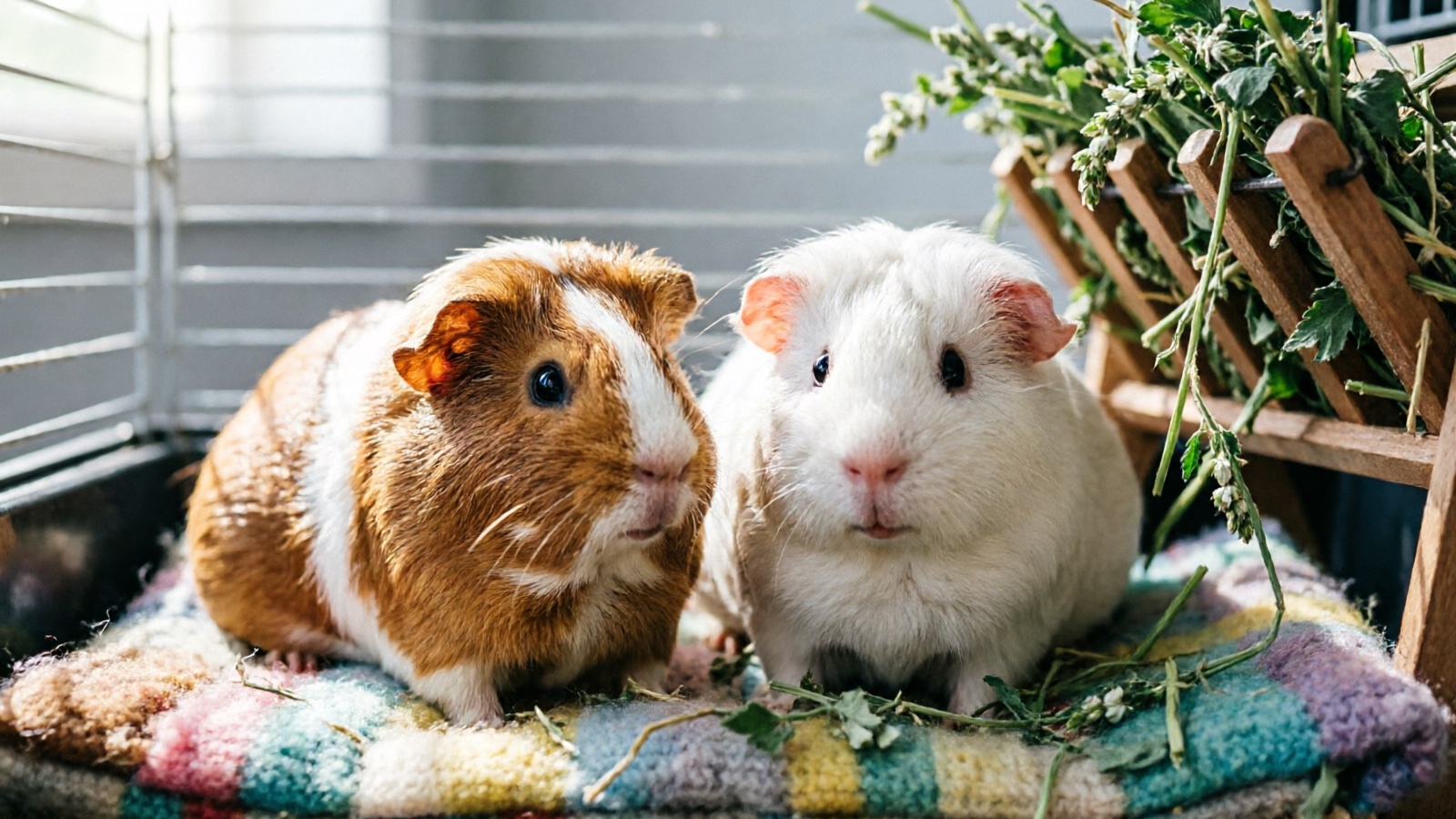
Guinea pigs are one of the best small mammal pets for families. They’re gentle — they rarely bite, and when they do, it’s usually because a finger smelled like food. They’re diurnal, meaning they’re active during the day when you’re awake to interact with them. Their vocalizations are charming and expressive: the famous “wheek” is a high-pitched whistle demanding food, “purring” means contentment, and “popcorning” (jumping straight up in the air) means pure happiness.
Their 5-7 year guinea pig lifespan is significantly longer than hamsters (2-3 years), which means a deeper bond but also a longer commitment. There are 13+ recognized guinea pig breeds ranging from the smooth-coated American to the extravagant Peruvian with floor-length hair. Each breed has slightly different grooming needs, but the core care requirements — diet, housing, socialization — remain the same across all breeds.
Housing and Cage Setup
Minimum Cage Size (This Is Non-Negotiable)
The single biggest mistake new guinea pig owners make is buying a cage that’s too small. Most pet store cages marketed for guinea pigs are 4-6 sq ft — that’s barely adequate for one pig, and completely unacceptable for a pair. Guinea pigs are ground-dwelling animals that need horizontal floor space to run, popcorn, and explore.
| Number of Guinea Pigs | Minimum Floor Space | Recommended |
|---|---|---|
| 1 pig (not recommended) | 7.5 sq ft | 10.5 sq ft |
| 2 pigs (recommended) | 10.5 sq ft | 13 sq ft |
| 3 pigs | 13 sq ft | 16 sq ft |
Cage Type: C&C Cages Are the Gold Standard
C&C cages (Coroplast plastic base + wire storage cube grids) are the standard recommendation from every guinea pig rescue and welfare organization I know of. They’re affordable ($50-80 for a basic setup), infinitely customizable (add sections as your herd grows), and provide maximum floor space for the price. You can build a 2x4 grid cage (10.5 sq ft) in about 30 minutes with no tools.
For a pre-made alternative, the Tresbro Guinea Pig Cage with its waterproof mat and transparent panels works well as an indoor playpen or supplementary space, though I’d still recommend a C&C setup as the primary enclosure for the floor space advantage.
Avoid: tall cages with multiple levels (guinea pigs are poor climbers and can fall), aquariums (poor ventilation), and any cage under 7.5 sq ft. For detailed sizing guidance, see our guinea pig cage size guide and best guinea pig cage recommendations.
Bedding
Safe bedding options include paper-based bedding and fleece liners. Paper bedding is the most popular choice — it’s absorbent, dust-free (when you buy quality), and easy to spot-clean. Fleece liners are reusable and cost-effective long-term but require frequent washing.
Avoid at all costs: pine and cedar shavings. They contain phenols — aromatic oils that cause respiratory irritation and liver damage in guinea pigs. This isn’t debatable; the veterinary consensus is clear.
Kaytee Clean & Cozy paper bedding is a reliable choice — 99.9% dust-free and absorbs six times its weight in moisture. For more bedding options and a full comparison, check our guinea pig bedding guide.
Location
Place the cage in a room-temperature area (65-75°F / 18-24°C). Guinea pigs are sensitive to heat — above 80°F can cause heatstroke. Keep the cage away from direct sunlight, drafts, AC vents, and high-traffic areas. A low-traffic room where the family spends time is ideal — guinea pigs enjoy being near their people and will wheek when you walk by.
Diet and Nutrition
The Golden Ratio: 80-10-5-5
Guinea pig nutrition is straightforward once you understand the ratio. Everything they eat should fall into one of four categories:
| Component | Percentage | Daily Amount | Notes |
|---|---|---|---|
| Timothy hay | 80% | Unlimited | Digestion + teeth wear |
| Fresh vegetables | 10% | ~1 cup | Vitamin C source |
| Fortified pellets | 5% | 1/8 cup | Supplement only |
| Treats | 5% | Occasional | Fruit, herbs |
Hay is the foundation. Timothy hay should be available 24/7 in unlimited quantities. It provides the long-strand fiber essential for gut motility (guinea pig digestive systems literally need fiber moving through them constantly), and the abrasive texture wears down their continuously growing teeth. Without adequate hay, dental problems and GI stasis are almost inevitable.
I use Small Pet Select 2nd Cutting Timothy Hay — the second cutting has softer stems than first cutting, which guinea pigs seem to prefer, while still providing enough abrasion for dental health.
Alfalfa hay should only be given to guinea pigs under 6 months old (higher calcium and protein needed for growth). Adult guinea pigs on alfalfa long-term can develop bladder stones from excess calcium.
The Vitamin C Requirement (Non-Negotiable)
This is the single most important thing to understand about guinea pig care, and the thing most beginners get wrong.
Guinea pigs, like humans and capybaras, have a genetic mutation — they lack the enzyme L-gulonolactone oxidase, which is required to synthesize vitamin C internally. Almost all other mammals can make their own vitamin C. Guinea pigs cannot. Without a daily dietary source of 30-50mg of vitamin C, a guinea pig will develop scurvy within 2-3 weeks.
Scurvy symptoms: lethargy, reluctance to move, joint pain, rough coat, swollen gums, bleeding, and in severe cases, death. It’s painful and entirely preventable.
Best dietary vitamin C sources (per 100g):
| Vegetable | Vitamin C Content | Notes |
|---|---|---|
| Red bell pepper | 128 mg | Best overall — high Vit C, low sugar |
| Kale | 120 mg | Excellent, but high calcium (limit frequency) |
| Parsley | 133 mg | Highest, but feed sparingly (calcium) |
| Green bell pepper | 80 mg | Good, less sweet than red |
| Romaine lettuce | 24 mg | Good base vegetable |
| Broccoli | 89 mg | Good, can cause gas in large amounts |
Practical approach: give your guinea pigs 1 cup of fresh vegetables daily, and make sure at least half of that is a vitamin C-rich vegetable like bell pepper or kale. Rotate vegetables throughout the week for variety.
For pellets, I recommend Oxbow Essentials Adult Guinea Pig Pellets — they’re fortified with stabilized vitamin C (important because vitamin C degrades quickly when exposed to light and air). Uniform pellets prevent selective eating, where pigs pick out the tasty bits and leave the nutritious parts.
Don’t rely solely on vitamin C drops added to water — the vitamin degrades quickly in water (within hours), and many guinea pigs drink less when the water tastes different. Fresh vegetables are the most reliable delivery method. For a complete breakdown, see our guinea pig food guide and best guinea pig food recommendations.
Foods to Avoid
Some foods are dangerous or unhealthy for guinea pigs: onions and garlic (toxic), potatoes and potato tops (solanine), rhubarb (oxalates), iceberg lettuce (mostly water, can cause diarrhea), avocado (too high in fat), chocolate and caffeine (toxic), and any processed human food. Fruit is fine as an occasional treat but the sugar content means no more than 1-2 small pieces per week.
Social Needs: They Need a Friend
This is the most commonly misunderstood aspect of guinea pig care, and I can’t emphasize it enough: guinea pigs are herd animals. In the wild, they live in groups of 10-30. A solitary guinea pig will become lonely, depressed, and stressed — this isn’t anthropomorphism, it’s documented behavioral science. Stressed guinea pigs are more susceptible to illness, eat less, and have shorter lifespans.
In Switzerland, it’s actually illegal to keep a single guinea pig — the law recognizes that solitary housing is harmful. While no other country has this law, the Swiss got it right.
Best pairings:
| Pairing Type | Compatibility | Notes |
|---|---|---|
| Two females (sows) | ✅ Excellent | Easiest pairing, rarely fight |
| Neutered male + female(s) | ✅ Excellent | Male must be neutered first (wait 4 weeks after surgery) |
| Two males (boars) | ⚠️ Possible | Need 13+ sq ft minimum, personality-dependent |
| Three+ pigs | ✅ Good | More stable group dynamics |
Boar pairs are the most challenging. Some boars get along beautifully for life; others will fight persistently regardless of cage size. If you’re a first-time owner, I’d recommend starting with two sows — it’s the path of least resistance.
Introductions must be done on neutral territory — not in either pig’s established cage. A neutral playpen or bathroom floor works well. Have hideouts with two entrances (so neither pig gets cornered), supervise closely, and be prepared to separate if serious fighting occurs. For more on guinea pig behavior, see our guinea pig sounds guide — they communicate a lot through vocalizations, and learning to read them helps you understand when they’re content versus stressed.
Daily and Weekly Care Routine
Daily (10-15 minutes)
- Check hay rack — refill if low (hay should never run out)
- Change water — fresh, room-temperature water daily
- Feed 1 cup fresh vegetables (include vitamin C source)
- Provide 1/8 cup fortified pellets
- Spot-clean soiled bedding areas
- Spend 30-60 minutes of interaction time
- Quick health observation: are they eating? Active? Breathing normally?
Weekly
- Full water bottle clean (scrub with bottle brush)
- Health check: eyes clear, nose dry, teeth aligned, coat smooth
- Weigh each pig on a kitchen scale (weight loss is often the first sign of illness)
- Check nails — trim every 2-3 weeks when they get long
Monthly
- Full cage clean with fresh bedding
- Deep clean water bottles and food bowls
- Thorough health assessment (body condition, skin check for parasites)
- Review diet — are they eating all their vegetables?
Handling and Bonding
Guinea pigs are prey animals, which means they’re naturally cautious. The key to handling is making them feel safe:
- Approach from the side, not from above — a hand coming from above looks like a bird of prey to a guinea pig
- Support the entire body — one hand under the chest, one supporting the hindquarters
- Start with short sessions — 5 minutes of lap time, gradually extending as they trust you
- Use a fleece blanket on your lap — it gives them secure footing and absorbs any accidents
- Never pick up by the scruff — this is painful and stressful
Lap time is the best bonding method. Sit on the floor with a towel or fleece, place your guinea pig on your lap with a small pile of hay or a vegetable, and let them come to you. Some guinea pigs will curl up and fall asleep on your lap within weeks; others always stay a bit wary. Both are normal.
For families with children, guinea pigs are generally good with supervised handling — see our guinea pig for kids guide for age-appropriate interaction guidelines.
Exercise and Enrichment
Guinea pigs aren’t particularly athletic — they won’t run on wheels or climb elaborate structures. What they need is floor time: a safe, enclosed area where they can run around, explore, and popcorn. A playpen set up on the floor for 30-60 minutes daily is ideal.
Beyond floor time, good enrichment includes:
- Tunnels — guinea pigs love running through them (PVC pipes or fabric tunnels work)
- Cardboard boxes with holes cut in the sides — cheap and disposable hiding spots
- Foraging — scatter vegetables around the cage instead of bowl-feeding sometimes
- Mirror — some guinea pigs enjoy seeing their reflection (not all respond to it)
- Guinea pig toys — chew sticks, toss toys, and crinkle tunnels
Guinea pigs will “popcorn” (jump straight up) when they’re happy and excited. If you’ve never seen it, it’s one of the most joyful things in small pet keeping — a sign that your guinea pig feels safe and content.
Health and Common Problems
Guinea pigs are generally healthy animals when properly cared for, but they’re good at hiding illness — a survival instinct from being prey animals. By the time a guinea pig shows obvious symptoms, the problem is often advanced. That’s why weekly weigh-ins are so important: a weight drop of 2-3 oz in a week is a red flag even if the pig seems fine otherwise.
| Issue | Symptoms | Action |
|---|---|---|
| Scurvy (vitamin C deficiency) | Lethargy, joint pain, rough coat, swollen gums, reluctance to move | Emergency vitamin C supplementation + vet |
| Respiratory infection | Sneezing, nasal/eye discharge, labored breathing | Vet + antibiotics (can progress fast) |
| Bumblefoot | Red, swollen foot pads, limping, reluctance to walk | Vet + improve bedding (see bumblefoot guide) |
| Mites / lice | Intense scratching, hair loss, especially behind ears | Vet treatment (ivermectin) |
| Dental problems | Drooling, weight loss, dropping food, wet chin | Vet (teeth may need filing) |
| Diarrhea | Loose stools, soiled bottom, dehydration | Diet correction, vet if persistent (>24h) |
| Urinary stones | Straining, blood in urine, squeaking while urinating | Vet immediately (often requires surgery) |
| GI stasis | Not eating, not pooping, bloated belly | Emergency vet (can be fatal within hours) |
Find an exotic vet before you need one. Guinea pigs aren’t treated by regular dog/cat veterinarians — you need a vet who specializes in exotic/small mammals. Establish a relationship with one before any problems arise. The guinea pig health guide has more detailed information on recognizing and managing common conditions.
Grooming
Grooming needs vary by breed, but every guinea pig needs some basic maintenance:
Nail trimming: every 2-3 weeks. Long nails curve inward and can cause pain and difficulty walking. Use small animal nail clippers and have styptic powder on hand in case you cut the quick (it bleeds surprisingly much for such a small animal). If you can hear nails clicking on hard surfaces, they’re too long.
Brushing: short-haired breeds (American, Abyssinian) need brushing once a week. Long-haired breeds (Peruvian, Silkie) need daily brushing to prevent painful mats. A soft-bristle brush or greyhound comb works well.
Bathing: rarely needed — 1-2 times per year maximum. Guinea pigs groom themselves, and bathing strips natural oils from their coat, can lower body temperature dangerously, and is highly stressful. If you must bathe (for a medical reason), use guinea pig-safe shampoo, lukewarm water, and dry thoroughly immediately.
Teeth check: weekly visual check. Healthy teeth should be aligned, white, and not overgrown. If you notice drooling, wet chin, or difficulty eating, see a vet.
Cost Breakdown
Initial Setup (Pair of Guinea Pigs)
| Item | Cost Range |
|---|---|
| C&C cage materials or equivalent | $50-120 |
| Bedding (first supply) | $15-25 |
| Timothy hay (first bag) | $15-25 |
| Pellets (first bag) | $10-15 |
| Water bottles (x2) | $15-20 |
| Food bowls (x2) | $10-15 |
| Hideouts (at least 2) | $15-25 |
| Nail clippers | $8-12 |
| Kitchen scale (for weigh-ins) | $10-15 |
| Total initial setup | $148-267 |
Monthly Costs (Pair)
| Item | Monthly Cost |
|---|---|
| Timothy hay (unlimited) | $15-25 |
| Fortified pellets | $5-8 |
| Fresh vegetables | $8-15 |
| Bedding refill | $12-20 |
| Treats and supplements | $3-5 |
| Monthly total | $43-73 |
One-year cost for a pair: approximately $650-1,100 including initial setup. Over a 5-7 year lifespan, you’re looking at roughly $3,000-6,000 total. This isn’t a trivial expense, but it’s significantly less than a dog or cat over the same period.
Frequently Asked Questions
Are guinea pigs hard to take care of?
Guinea pigs are moderate-effort pets. They need daily fresh vegetables (vitamin C), weekly cage cleaning, regular nail trims, and at least 30-60 minutes of interaction per day. The biggest commitment is that they need a companion — you should never keep just one. Monthly costs are $40-80, and they live 5-7 years. Compared to hamsters, they need more space and more daily attention, but they’re also more interactive and rewarding during that time.
Do guinea pigs need a friend?
Yes — guinea pigs are herd animals and must live in pairs or small groups. A single guinea pig will become lonely, depressed, and stressed. In Switzerland, it’s actually illegal to keep just one guinea pig. The best pairings are two females (sows) or a neutered male with one or more females. I’ve seen the difference between solo and paired guinea pigs many times — bonded pairs are visibly more active, vocal, and content.
What do guinea pigs need daily?
Daily requirements include unlimited timothy hay, 1/8 cup of fortified pellets, about 1 cup of fresh vegetables (including a vitamin C source like bell peppers), fresh water, and 30-60 minutes of interaction. Weekly needs include cage spot-cleaning, a weigh-in, and a basic health check. Monthly, you’ll do a full cage clean and nail trim. The daily time commitment is modest — maybe 15 minutes of active care plus interaction — but it needs to be consistent.
What should guinea pigs eat?
80% unlimited timothy hay, 10% fresh vegetables (about 1 cup daily, including vitamin C-rich ones like bell peppers and kale), 5% fortified pellets (1/8 cup), and 5% occasional treats. Guinea pigs cannot synthesize vitamin C and will develop scurvy without daily supplementation through fresh vegetables or vitamin C-fortified pellets. The hay is non-negotiable — it drives their entire digestive system. See our guinea pig food guide and vitamin C guide for more detail.
How big should a guinea pig cage be?
Minimum 7.5 sq ft for one guinea pig, 10.5 sq ft for a pair. I’d recommend 10.5-13 sq ft for a pair as the real minimum — guinea pigs need space to run and popcorn. C&C cages (Coroplast base with wire grid walls) are the most popular and cost-effective option. Avoid pet store cages — most are far too small. Floor space matters much more than height since guinea pigs don’t climb.
How much does a guinea pig cost per month?
Expect $40-80 per month for a pair of guinea pigs. The biggest ongoing expense is hay ($15-25/month for unlimited supply). Other costs include pellets ($5-8), fresh vegetables ($8-15), bedding ($12-20), and occasional treats ($3-5). Initial setup for a pair runs $150-270 including cage, bedding, food, water bottles, and basic supplies. Over a typical 5-7 year lifespan, total cost ranges from approximately $3,000-6,000 for a pair.
Do guinea pigs need vitamin C?
Yes — this is absolutely critical and the most important thing to understand about guinea pig nutrition. Guinea pigs are one of the few mammals that cannot synthesize their own vitamin C (they lack the L-gulonolactone oxidase enzyme). Without daily vitamin C intake of 30-50mg, they develop scurvy within 2-3 weeks. Symptoms include lethargy, joint pain, rough coat, swollen gums, and eventually death. Provide vitamin C through daily fresh vegetables (red bell peppers are the best source at 128mg per 100g) or vitamin C-fortified pellets.
How long do guinea pigs live?
Guinea pigs live 5-7 years on average with good care, and some reach 8 years with excellent care and genetics. This is a significant commitment — comparable in many ways to a dog’s senior years. Factors that affect lifespan include diet quality (especially consistent vitamin C), living conditions (proper cage size and clean bedding), social companionship (paired pigs live longer), and access to an exotic vet when health problems arise.