Most guinea pig cages sold in pet stores are dangerously small. The typical pet store cage provides 4-6 square feet of floor space — yet the minimum guinea pig cage size per the Humane Society’s recommendation for a pair of guinea pigs is 7.5 square feet. That gap between what’s sold and what’s actually needed is the single biggest mistake new owners make.
This guide covers everything you need to know about guinea pig cage size: minimum requirements based on the number of pigs, why floor space matters far more than height, C&C cage setups, the best cage size for guinea pigs compared side by side, and guinea pig cage setup tips to maximize every square foot. Proper cage sizing directly impacts guinea pig health — cramped conditions lead to stress, aggression, obesity, and respiratory infections that shorten your guinea pig’s lifespan.
How Big Should a Guinea Pig Cage Be?
The short answer: bigger than you think. The long answer depends on how many guinea pigs you have, but the universal principle is that floor space is the single most important factor in cage quality.
Minimum vs Recommended Size (Per Pig)
| Standard | Per Pig | 2 Pigs | 3 Pigs | 4 Pigs |
|---|---|---|---|---|
| Pet store standard | 2-3 sqft | 4-6 sqft | ❌ Too small | ❌ Too small |
| Minimum (Humane Society) | 7.5 sqft | 7.5 sqft | 10.5 sqft | 13 sqft |
| Recommended | 10.5 sqft | 10.5 sqft | 13 sqft | 16 sqft |
| Ideal | 13+ sqft | 13+ sqft | 16+ sqft | 20+ sqft |
The difference between a pet store cage and the recommended size is dramatic. A standard pet store cage for two pigs offers about 4-6 square feet — less than half of the recommended 10.5 square feet. Cramped cages cause stress, aggression, obesity, and higher risk of respiratory infections. The right guinea pig bedding helps absorb waste, but can’t compensate for insufficient space.
Guinea Pig Cage Size for 2, 3, and 4+ Pigs
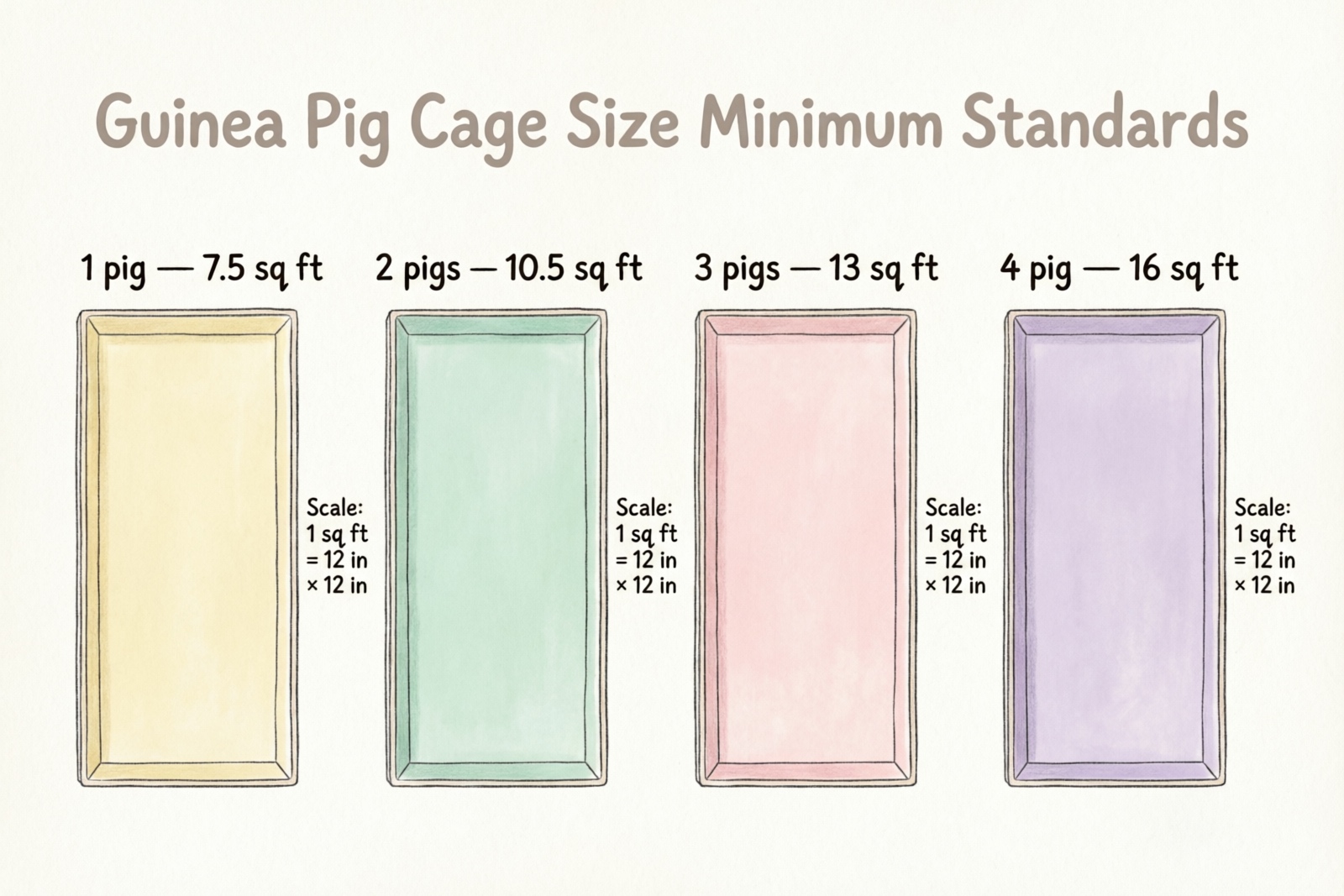
Cage Size Chart by Number of Pigs
| Number | Minimum (sqft) | Recommended (sqft) | Suggested Size (inches) | Cage Type |
|---|---|---|---|---|
| 1 pig | 7.5 | 10.5 | 30 × 50 | Medium |
| 2 pigs | 7.5 | 10.5 | 30 × 50 | Medium / C&C 2×3 |
| 3 pigs | 10.5 | 13 | 30 × 62 | Large / C&C 2×4 |
| 4 pigs | 13 | 16 | 30 × 76 | Large / C&C 2×5 |
| 5+ pigs | 16+ | 20+ | Custom C&C | Custom C&C |
When planning a guinea pig cage size for 3, the jump from 2 to 3 pigs is significant — you go from 7.5 to 10.5 square feet minimum. If you’re considering adding a third guinea pig to your pair, plan the cage upgrade before you bring the new pig home. Introducing a new pig into an already-crowded cage almost always leads to territorial conflicts.
Same-Sex vs Mixed Groups
Group composition affects space needs:
- Two sows (females): 7.5 sqft minimum — sows generally coexist peacefully
- Two boars (males): 10.5 sqft recommended — boars are more territorial and need extra space to establish separate areas
- Mixed sex: Never house intact males and females together. Guinea pigs reach sexual maturity at 4-6 weeks, and a pair can produce several litters per year. If you must house a mixed pair, both must be neutered/spayed by a guinea pig-savvy veterinarian
- Boar pairs need more space to reduce dominance disputes. If your boars are frequently teeth-chattering or mounting, the cage may be too small rather than a compatibility issue
Can Guinea Pigs Live Alone?
No. Guinea pigs are highly social herd animals. In Switzerland, it’s illegal to own a single guinea pig. A solitary pig becomes depressed and may develop abnormal behaviors like fur-pulling or repetitive pacing. No amount of human interaction replaces guinea pig companionship.
Why Floor Space Matters More Than Height
Guinea Pigs Are Ground Dwellers
Unlike hamsters or chinchillas, guinea pigs do not climb. They are ground-dwelling rodents — their legs are short and not built for ramps. Height in a cage is wasted space. Hard flooring without proper guinea pig bedding can cause bumblefoot — a painful foot infection that’s difficult to treat.
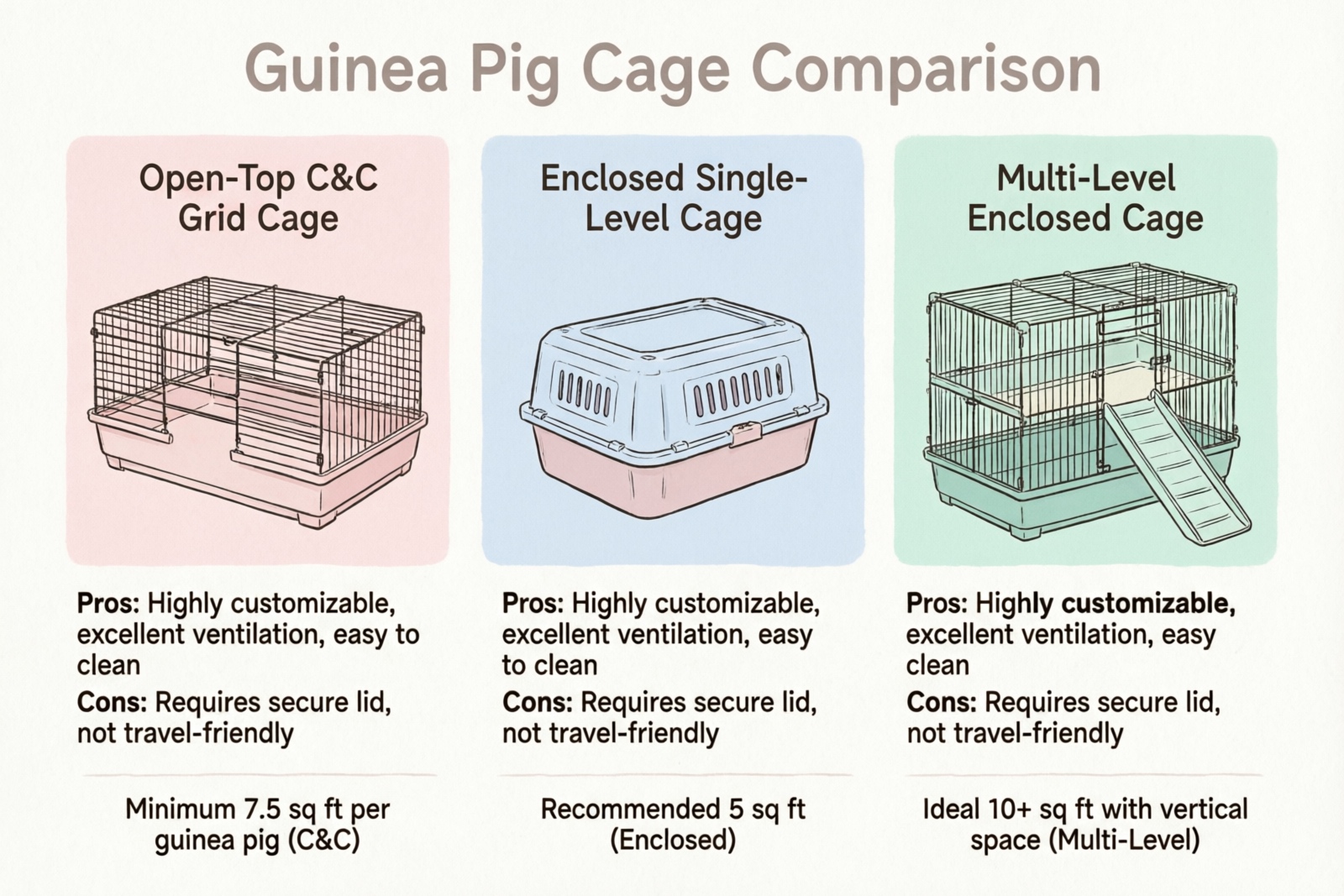
Multi-Level Cages — Not Recommended
Multi-level cages are a common mistake in guinea pig housing:
- Ramps too steep — Guinea pigs have weak hind legs; ramps over 30 degrees are difficult or impossible to climb
- Upper levels unused — Most guinea pigs avoid upper levels entirely
- Fall risk — Falls from even modest heights can injure pigs, especially seniors
- Cleaning difficulty — Multiple levels make cage maintenance significantly harder
Bottom line: A single-level cage with maximum floor space is always the better choice.
C&C Cages — The Gold Standard
What Is a C&C Cage?
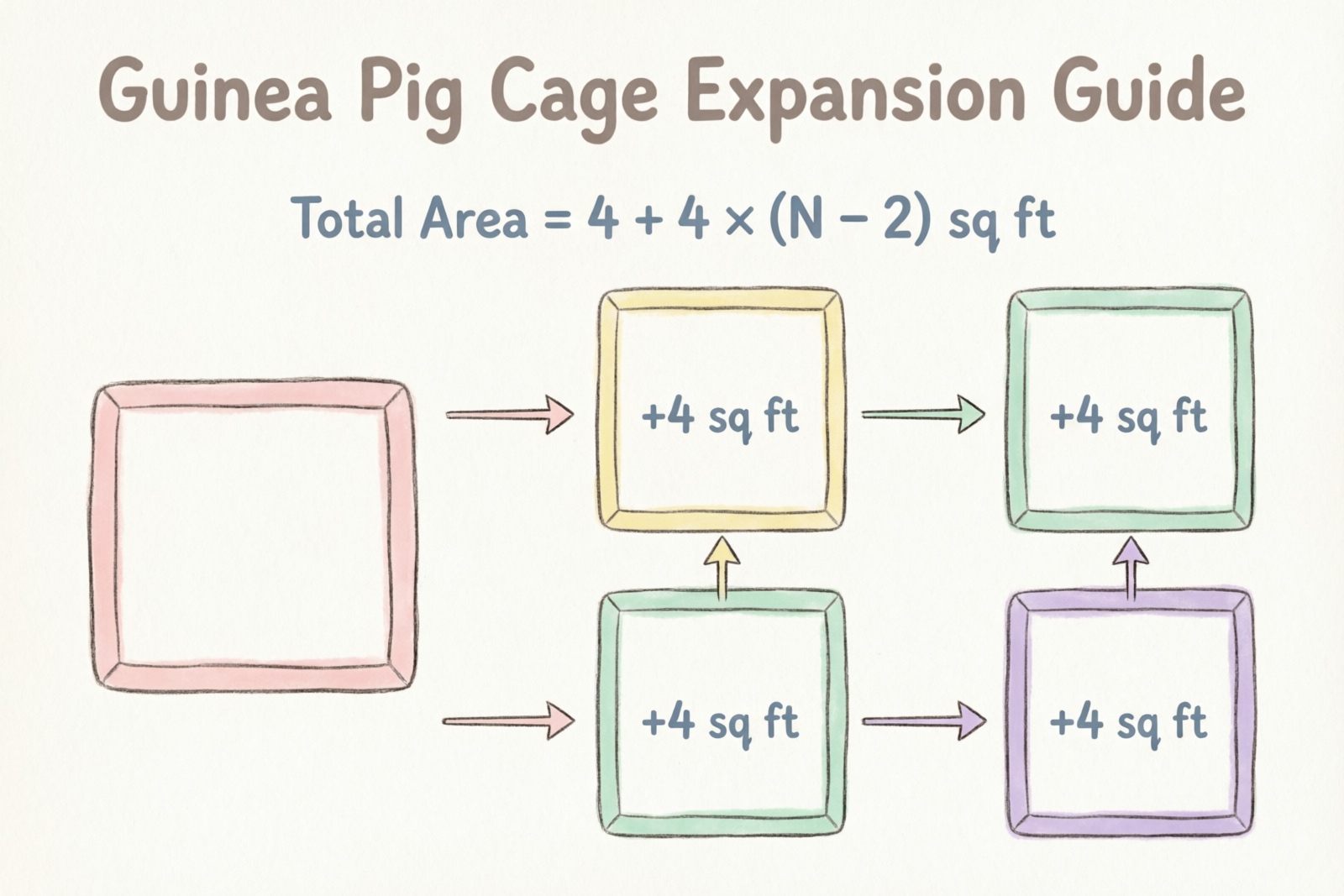
C&C cages stand for Cubes (wire storage grids) and Coroplast (corrugated plastic sheeting). Wire grids form the walls, and corrugated plastic forms a waterproof bottom tray with 6-inch sides. These modular setups scale to any need — originally popularized by guineapigcages.com, C&C cages have become the gold standard for guinea pig housing. You can build one in 30-60 minutes for far more space than commercial cages at lower cost.
I’ve helped several friends build C&C cages, and the results are consistently better than any pre-made option. The modular design means you can expand later by adding more grids — something that’s impossible with most commercial cages.
C&C Grid Size Guide
| Configuration | Size (inches) | Area (sqft) | Suitable For |
|---|---|---|---|
| 2×2 grids | 28 × 28 | 5.5 | ❌ Too small |
| 2×3 grids | 28 × 42 | 8.2 | 1-2 pigs (minimum) |
| 2×4 grids | 28 × 56 | 10.9 | 2-3 pigs (recommended) |
| 2×5 grids | 28 × 70 | 13.6 | 3-4 pigs (recommended) |
| 2×6 grids | 28 × 84 | 16.3 | 4-5 pigs (ideal) |
Each standard grid is 14 inches square. A 2×4 configuration gives 28” × 56” — approximately 10.9 square feet, meeting the recommended size for 2-3 guinea pigs at lower cost than most commercial cages.
C&C Cage Supplies
Building a C&C cage requires:
- Grids: Standard 14” × 14” wire storage cube grids (16+ grids for a 2×4 cage)
- Coroplast: 4mm corrugated plastic sheet (~45” × 73” for a 2×4 cage)
- Connectors: Plastic cube connectors or zip ties
- Total DIY cost: $40-80
Safety note: Grid openings must be 1.5 inches or smaller. Some newer grids have wider spacing that a guinea pig’s head can fit through — always measure before buying.
Best Guinea Pig Cages Compared
When evaluating cages, I’d focus on floor space above everything else. A cage with all the accessories in the world is still inadequate if it doesn’t provide enough room for your guinea pigs to move freely.
MidWest Homes for Pets Guinea Habitat
The MidWest Homes for Pets Guinea Habitat Cage ($59.99, 4.1 stars) is the most commonly recommended starter cage, and for good reason. The key feature is its expandable design — connect multiple units together to create a larger enclosure. A single unit provides about 8 square feet, but two connected units give you approximately 16 square feet for 2-3 guinea pigs at the recommended standard.
Tool-free assembly takes under 10 minutes, and the washable PVC bottom is practical for cleaning. I’d recommend this to first-time owners specifically because of the expandability — you can start with one unit and add a second when budget allows, rather than buying an adequate cage upfront.
The main limitation: a single unit at ~8 sqft is below the recommended 10.5 sqft for a pair. I’d plan to either buy two units from the start or pair a single MidWest with a C&C extension.
Oneluck Guinea Pig Cage Indoor Habitat
The Oneluck Guinea Pig Cage ($114.99, 4.1 stars) offers significantly more floor space than basic options — closer to the recommended 10.5+ square feet for a pair right out of the box. The waterproof plastic bottom is more durable than canvas, and the included playpen extension and removable partition add flexibility.
The partition is particularly useful for introducing a new guinea pig — you can separate them visually while they get used to each other’s scent. At $114.99, this is the best all-in-one option I’ve found for owners who want adequate space without building a C&C cage.
VISCOO 41 Panels Pet Playpen
The VISCOO 41 Panels Pet Playpen ($48.99, 4.6 stars) is the most budget-friendly way to create a large enclosure. You can configure 41 panels into various shapes to fit your space, and the included waterproof mat protects your floor. At under $50, it’s an excellent C&C alternative for owners who don’t want to build from scratch.
The open-top design means you’ll need a safe room — no cats, dogs, or small children who could reach in. The panels are also less sturdy than proper C&C grids, so determined guinea pigs may push them around. I’d recommend securing the panels together with zip ties for added stability.
Amazon Basics Leakproof Guinea Pig Cage
The Amazon Basics Leakproof Guinea Pig Cage ($41.94, 4.2 stars) is the most affordable entry point at under $42. The leakproof canvas bottom prevents urine from reaching your floor, which is a genuinely useful feature.
However, floor space is approximately 8 square feet — below the recommended 10.5 sqft for two pigs. I’d only recommend this for a single guinea pig or as a temporary/quarantine cage. For a permanent home for a pair, you’d need to combine it with a playpen extension or plan to upgrade.
Cage Comparison Summary
| Cage | Floor Space | Price | Best For | Rating |
|---|---|---|---|---|
| Amazon Basics | ~8 sqft | $41.94 | Single pig / temporary | ⭐⭐⭐ |
| MidWest Habitat | ~8 sqft (expandable) | $59.99 | Entry-level, can expand | ⭐⭐⭐⭐ |
| Oneluck Habitat | ~10.5+ sqft | $114.99 | 2 pigs, all-in-one | ⭐⭐⭐⭐ |
| VISCOO Playpen | Configurable | $48.99 | Budget large space | ⭐⭐⭐⭐ |
A note on pet store cages like the Ferplast Cavie: these typically offer 4-6 square feet with accessories included, but the floor space alone makes them inadequate by modern standards. I’d avoid them unless you need a small travel or quarantine cage.
Indoor Cage Size Considerations
Best Room Locations
Where you place the cage matters as much as its size. Guinea pigs are sensitive to temperature and drafts.
- ✅ Temperature-stable rooms: 65-75°F (18-24°C). Guinea pigs cannot sweat and are susceptible to heatstroke above 80°F
- ✅ Good ventilation without direct drafts
- ✅ Quiet areas away from high-traffic zones
- ❌ Kitchen/bathroom: humidity promotes respiratory issues
- ❌ Garage: temperature extremes and exhaust fumes
- ❌ Direct sunlight: causes overheating
Floor Protection
Even well-designed cages allow some bedding to escape. A waterproof mat or vinyl tablecloth under the cage protects flooring and makes cleanup easier. For a large guinea pig cage or C&C setup, a waterproof mat is essentially mandatory.
I’ve found that a cheap vinyl tablecloth from a dollar store works just as well as dedicated cage mats — the key is having something waterproof underneath that extends at least 6 inches beyond the cage edges on all sides. Bedding gets kicked out during popcorning sessions, and the mat catches it all.
What About Outdoor Cages?
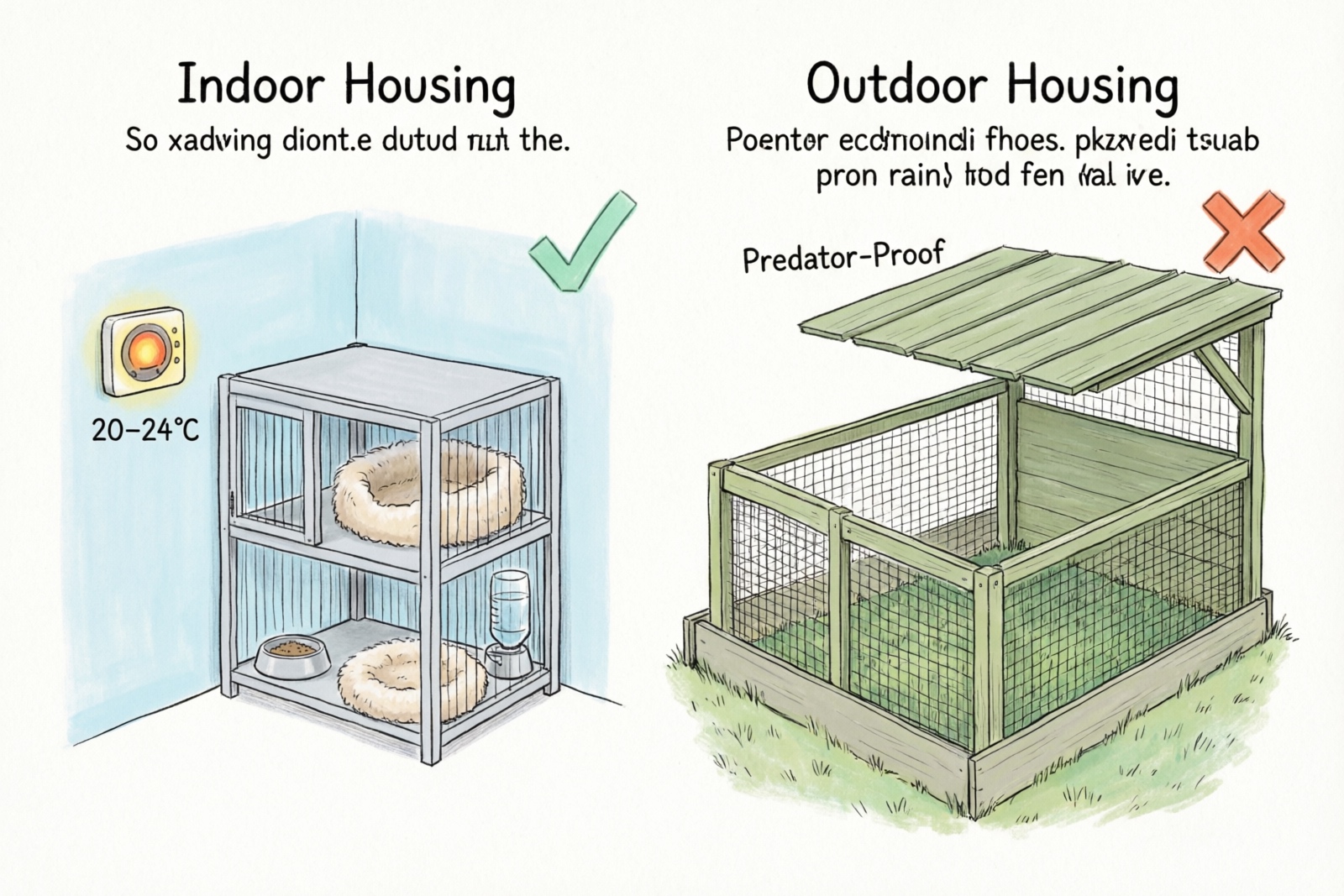
Outdoor cages and runs can provide excellent additional space during warm months, but they come with serious risks that indoor cages don’t. Predators (hawks, cats, foxes, raccoons) can reach through or dig under outdoor enclosures. Temperature fluctuations are harder to control — guinea pigs are sensitive to both heat (above 80°F) and cold (below 60°F). Insects and parasites are more common outdoors.
If you do use an outdoor run, I’d recommend it only for supervised daytime access during mild weather (65-75°F), with a secure wire cover and solid bottom to prevent both escape and predator access. Never leave guinea pigs outside overnight. An outdoor run is a supplement to an indoor cage, not a replacement.
Cage Setup — Layout Tips for Maximum Space
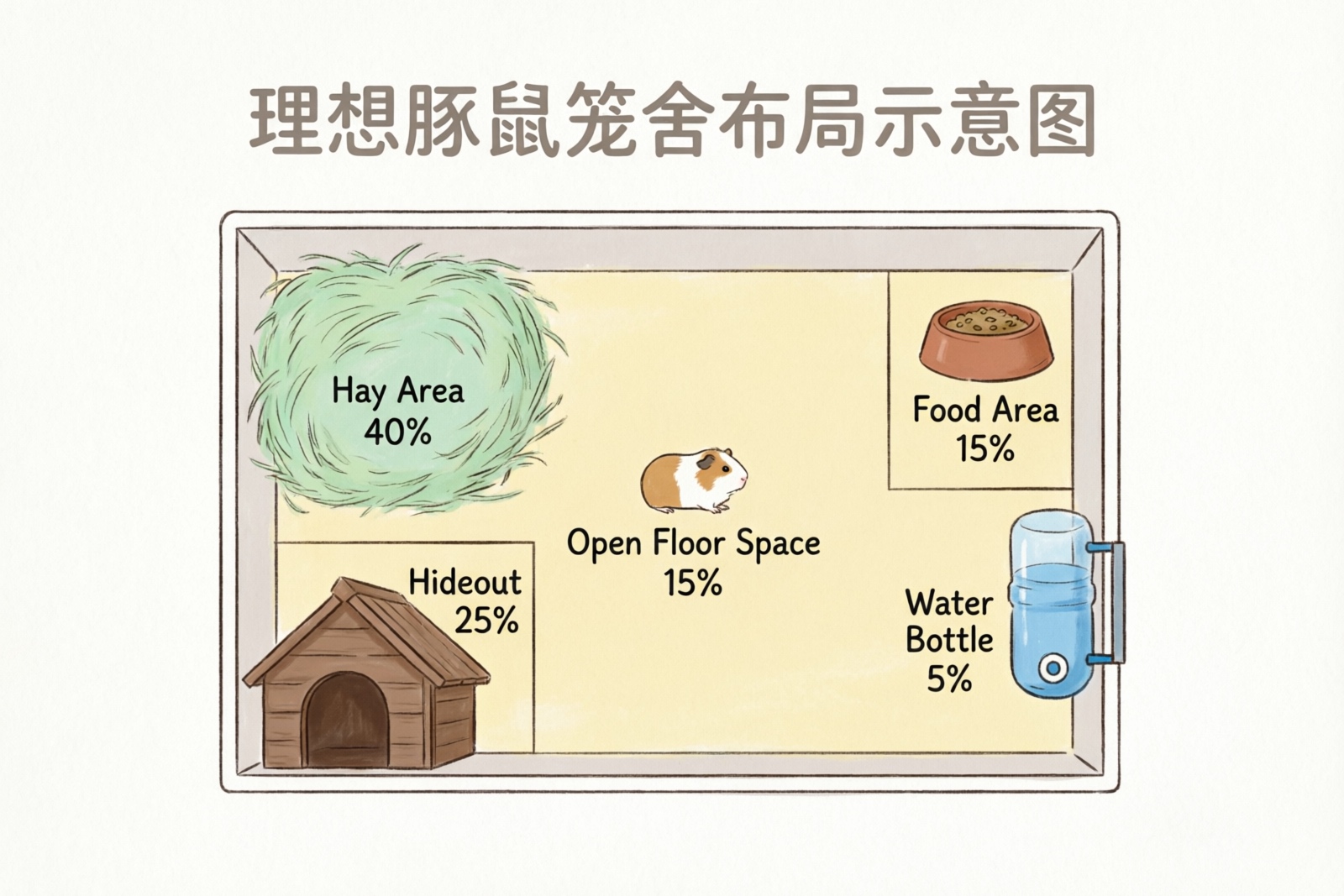
Ideal Cage Layout (2-Pig Example)
| Zone | Percentage | Contents |
|---|---|---|
| Hay area | 30% | Large hay pile + food bowl |
| Rest area | 25% | 2 hideouts (one per pig) |
| Activity area | 30% | Open running space + guinea pig toys |
| Utilities | 15% | Water bottle + litter area |
The hay area should be the largest zone because guinea pigs spend 70-80% of their waking time eating. A wall-mounted hay rack keeps the hay accessible while reducing floor clutter. The activity zone must remain at least 60% open floor space — avoid overcrowding with accessories.
Space-Saving Tips
- Wall-mounted hay racks free up significant floor space. Hay is the foundation of guinea pig food, so this area deserves the most real estate
- Flat hideouts take up less space than dome-shaped ones while still providing the enclosed shelter guinea pigs need
- Hang water bottles on the cage wall rather than using freestanding bowls that tip over
- Corner litter boxes consolidate waste in one area, making the rest of the cage cleaner
Recommended Cage Accessories
A properly sized cage needs the right accessories to function well. A wood hideout like the Niteangel Wood House with Window ($26.99, 4.4 stars) provides shelter while the window design allows ventilation and monitoring. Every guinea pig needs at least one hiding spot — ideally one per pig. A dedicated cage cleaner like the Amazing Small Animal Cage Cleaner ($16.99, 4.6 stars) makes spot cleaning faster and more effective, which matters more as cage size increases.
Cage Size Mistakes to Avoid
1. Buying a pet store cage without checking dimensions The most common mistake. Always calculate square footage before purchasing. Measure the interior floor space (not exterior dimensions) and compare against the minimum 7.5 sqft per pig standard. A cage labeled “for 2 guinea pigs” at a pet store may only provide 5-6 square feet.
2. Choosing height over floor space A tall cage looks impressive but provides no benefit for ground-dwelling guinea pigs. Multi-level cages with ramps are particularly problematic — the ramps are too steep, the upper levels go unused, and falls are a real risk. Always prioritize a wide, single-level design.
3. Housing a single guinea pig in a large cage Some owners think a large cage compensates for a solitary guinea pig. It doesn’t. Guinea pigs need companionship of their own species. A large cage with one pig is better than a small cage, but it doesn’t solve the fundamental social need.
4. Overfilling the cage with accessories Every hideout, toy, tunnel, and food bowl reduces the open running space. A 10.5 square foot cage packed with accessories may effectively provide only 6-7 square feet of usable space. Keep at least 60% of the floor open.
5. Not planning for growth Many owners start with a pair and later add a third guinea pig — only to discover the cage is too small. If you might expand your herd, choose an expandable cage like the MidWest or build a C&C cage that can be enlarged with additional grid panels. Chronic crowding leads to stress behaviors — teeth chattering, chasing, and fighting. Stressed guinea pigs also produce abnormal guinea pig sounds like distress squealing that owners often mistake for personality conflicts when the real problem is insufficient space.
FAQ: Guinea Pig Cage Size Questions
How big should a guinea pig cage be?
Minimum 7.5 square feet per guinea pig (Humane Society standard), but 10.5 square feet per pig is recommended. For a pair, that means at least a 30” × 50” enclosure at minimum, preferably larger.
What is the minimum cage size for 2 guinea pigs?
7.5 square feet is the absolute minimum for a pair, but 10.5 square feet is the recommended size. A 2×3 or 2×4 C&C cage configuration provides the best value and adequate space.
Can guinea pigs live in a small cage?
They can survive, but not thrive. Small cages cause chronic stress, aggression between cage mates, obesity from lack of exercise, and respiratory problems from ammonia buildup. Proper guinea pig bedding helps absorb waste, but adequate space is irreplaceable.
What is a C&C cage?
C&C stands for Cubes (wire storage grids) and Coroplast (corrugated plastic sheeting). It’s a modular cage system that you can build yourself for $40-80 or buy as a pre-made kit. C&C cages offer the best combination of size, cost, and customizability for guinea pig housing.
Are multi-level cages good for guinea pigs?
No. Guinea pigs are ground dwellers that don’t climb. Ramps in multi-level cages are too steep for their short legs, upper levels typically go unused, and falls can cause injuries. A single-level cage with maximum floor space is always better.
How much floor space do guinea pigs need?
Minimum 7.5 square feet per pig, recommended 10.5 square feet per pig. Floor space is far more important than cage height. Guinea pigs spend their lives on the ground — vertical space provides no meaningful benefit.
Guinea Pig Cage Size Quick Reference
- 1 pig: 7.5 sqft minimum / 10.5 sqft recommended
- 2 pigs: 7.5 sqft minimum / 10.5 sqft recommended
- 3 pigs: 10.5 sqft minimum / 13 sqft recommended
- 4 pigs: 13 sqft minimum / 16 sqft recommended
- Best overall: C&C 2×4 cage (10.9 sqft, 2-3 pigs)
- Temperature range: 65-75°F (18-24°C)
- Golden rule: Floor space > height, always
- Never house alone: Minimum 2 guinea pigs
- 60% open floor: Don’t overfill with accessories