⚠️ Medical Disclaimer: This article is for informational purposes only and is not a substitute for professional veterinary advice. Guinea pig bumblefoot can become serious if left untreated. Always consult a licensed veterinarian for proper diagnosis and treatment, especially if symptoms worsen or your guinea pig shows signs of pain or distress.
What is Guinea Pig Bumblefoot?
Guinea pig bumblefoot, medically known as pododermatitis, is a painful inflammatory condition affecting the feet and footpads of guinea pigs. The name “bumblefoot” comes from the characteristic swollen, red appearance of infected feet—they look like small bumblebees attached to the bottom of your pet’s paws.
This condition develops when pressure, trauma, or moisture damages the sensitive skin on your guinea pig’s feet, allowing bacteria (most commonly Staphylococcus aureus) to enter and cause infection. Without proper treatment, guinea pig bumblefoot progresses through increasingly severe stages, potentially leading to deep tissue infection, bone involvement, and in extreme cases, systemic illness.
Medical Definition & Severity Levels
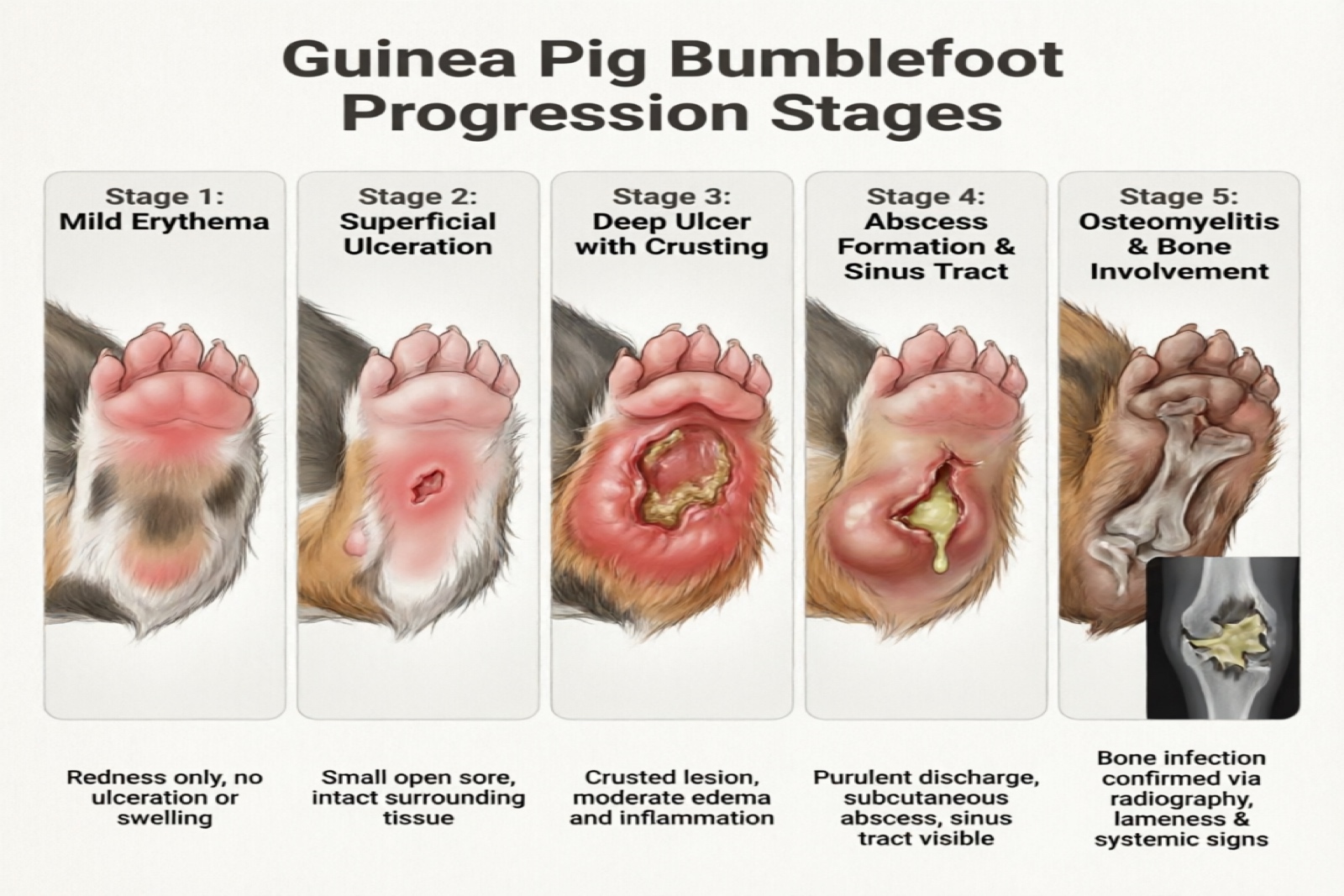
Veterinarians classify bumblefoot into five stages based on severity:
Stage 1 (Mild):
- Slight redness on footpad
- No swelling or ulceration
- Hair loss on affected area
- Easily treatable at home
Stage 2 (Moderate):
- Noticeable redness and inflammation
- Mild swelling of footpad
- Small scabs or crusts forming
- May require home treatment + veterinary consultation
Stage 3 (Moderate-Severe):
- Significant swelling
- Open sores or ulcers present
- Crusts with underlying infection
- Veterinary care recommended
Stage 4 (Severe):
- Large abscesses or pus-filled pockets
- Deep tissue involvement
- Possible tendon damage
- Immediate veterinary attention required
Stage 5 (Critical):
- Bone infection (osteomyelitis)
- Possible sepsis
- Life-threatening condition
- Emergency veterinary care essential
How Common is Guinea Pig Bumblefoot?
Guinea pig bumblefoot is one of the most common foot problems in pet guinea pigs, affecting an estimated 15-25% of captive guinea pigs at some point in their lives. Certain groups face higher guinea pig bumblefoot risk:
- Obese guinea pigs: Excess weight increases pressure on feet
- Senior guinea pigs: Thinner skin and reduced mobility
- Guinea pigs with diabetes: Impaired healing and immune function
- Those housed on wire flooring: Direct trauma to footpads
- Vitamin C deficient pigs: Weakened skin integrity and immune response
Early detection makes treatment significantly easier—Stage 1 guinea pig bumblefoot often resolves with simple environmental changes, while Stage 4-5 cases may require weeks of intensive veterinary treatment.
For comprehensive information on overall guinea pig health problems, including conditions that increase bumblefoot risk, see our complete health guide.
What Causes Guinea Pig Bumblefoot?
Understanding how guinea pigs get bumblefoot helps you prevent this painful condition. Guinea pig bumblefoot develops when multiple factors combine to create the perfect environment for infection.
Primary Causes
1. Hard or Rough Flooring Surfaces
The most common cause of guinea pig bumblefoot is prolonged contact with inappropriate flooring. Wire cage bottoms, rough wood, hard plastic, and even some commercial cage liners create constant pressure and abrasion on sensitive footpads.
Why it matters: Guinea pigs in the wild walk on soft grass, soil, and leaf litter. Their feet aren’t designed for hard, unyielding surfaces. Continuous pressure damages skin integrity, creating entry points for bacteria.
2. Wet and Dirty Bedding
Urine-soaked or feces-contaminated bedding creates a breeding ground for bacteria while simultaneously softening and irritating your guinea pig’s skin. This combination—damaged skin + high bacteria load—dramatically increases guinea pig bumblefoot risk.
Critical fact: Staphylococcus bacteria thrive in warm, moist environments. Wet bedding can contain bacterial concentrations 100-1000 times higher than dry, clean bedding.
3. Obesity and Excess Weight
Overweight guinea pigs place significantly more pressure on their footpads. A guinea pig that should weigh 2 pounds but weighs 3 pounds exerts 50% more pressure on each step—multiply this by thousands of steps per day, and tissue damage accumulates quickly.
4. Vitamin C Deficiency
Guinea pigs cannot manufacture their own vitamin C (like humans, they lack the necessary enzyme). Deficiency weakens collagen production, making skin fragile and slow to heal. Even subclinical deficiency—not severe enough to cause obvious scurvy symptoms—compromises foot health.
Risk Factors
Several factors increase bumblefoot susceptibility:
| Risk Factor | How It Contributes | Prevention |
|---|---|---|
| Small cage size | Concentrates pressure, limits movement | Minimum 7.5 sq ft for 1-2 pigs |
| Wire mesh flooring | Direct trauma, uneven pressure | Switch to solid bottom cages |
| Poor hygiene | Bacterial overgrowth | Daily spot-cleaning, weekly deep clean |
| Age (senior pigs) | Thinner skin, reduced circulation | Extra-soft bedding, regular foot checks |
| Limited exercise | Poor circulation, weight gain | Floor time, large cage, toys |
| Genetics | Some lines have weaker skin | Regular monitoring if prone to foot issues |
The Vicious Cycle of Guinea Pig Bumblefoot
Guinea pig bumblefoot creates a self-reinforcing cycle:
- Pressure/trauma damages skin → Minor inflammation
- Bacteria enter through micro-tears → Infection begins
- Swelling increases → More pressure on surrounding tissue
- Pain reduces movement → Less circulation, slower healing
- Infection spreads deeper → More swelling → More pain
Breaking this cycle requires addressing both the infection AND the underlying cause.
Guinea Pig Bumblefoot Symptoms: What to Look For
Recognizing what bumblefoot looks like on a guinea pig enables early intervention, dramatically improving guinea pig bumblefoot outcomes.
Early Warning Signs (Stage 1)
Visual indicators:
- Pink or red discoloration on one or more footpads
- Slight swelling, making the footpad appear fuller than normal
- Hair loss on the bottom of the feet
- Skin appears shiny or stretched
Behavioral changes:
- Increased licking or grooming of the feet
- Slight hesitation when walking on hard surfaces
- Preference for soft bedding areas
- Reluctance to be picked up (feet sensitive to touch)
What to do: These early signs are your window of opportunity. Immediate environmental improvements (better bedding, cage modifications) can reverse Stage 1 guinea pig bumblefoot within 1-2 weeks without medical intervention.
Progressive Symptoms (Stage 2-3)
Visual indicators:
- Obvious redness and inflammation across entire footpad
- Scabs, crusts, or calluses forming over affected areas
- Ulcers—open sores that may ooze fluid or pus
- Abscesses—swollen, pus-filled pockets under the skin
- Cracked or bleeding skin on footpads
Behavioral changes:
- Limping or favoring the affected foot
- Reduced activity—staying in one spot longer
- Decreased appetite (pain affects eating)
- Irritability when feet are touched
- Weight shifting while standing
What to do: Stage 2-3 guinea pig bumblefoot requires active treatment. Start home treatment protocols immediately (see next section) and consult your veterinarian if no improvement within 48-72 hours.
Severe Cases (Stage 4-5)
Visual indicators:
- Large, deep abscesses extending into underlying tissue
- Bleeding from wounds that won’t heal
- Black or necrotic tissue (dead tissue indicates severe infection)
- Swelling spreading up the leg
- Bone visible through ulcerated skin (Stage 5)
Behavioral changes:
- Inability to walk normally or at all
- Complete loss of appetite (emergency situation)
- Lethargy and depression
- Hunched posture indicating significant pain
- Grinding teeth (guinea pig sign of severe pain)
What to do: Contact your veterinarian immediately. Stage 4-5 bumblefoot can become life-threatening within days. These cases require professional treatment including surgical debridement, systemic antibiotics, and possibly amputation in extreme cases.
How to Treat Guinea Pig Bumblefoot at Home
⚠️ Important: Home treatment is appropriate for mild to moderate guinea pig bumblefoot only (Stage 1-3). Severe guinea pig bumblefoot (Stage 4-5) requires immediate veterinary care.
When Can You Treat Bumblefoot at Home?
You can attempt home treatment if:
- ✅ Symptoms are Stage 1-3 (redness, swelling, small scabs)
- ✅ No deep abscesses or exposed bone
- ✅ Your guinea pig is eating, drinking, and behaving normally otherwise
- ✅ You can improve environmental conditions immediately
- ✅ No signs of systemic illness (lethargy, loss of appetite)
⚠️ When to See a Veterinarian Immediately
Seek professional veterinary care if:
- 🚨 Stage 4-5 symptoms (large abscesses, bone exposure, necrotic tissue)
- 🚨 Active bleeding from foot wounds
- 🚨 Your guinea pig stops eating (gastrointestinal stasis risk)
- 🚨 No improvement after 48-72 hours of home treatment
- 🚨 Swelling spreads up the leg
- 🚨 Signs of systemic infection (fever, lethargy, rapid breathing)
Step-by-Step Home Treatment Guide
Step 1: Clean the Affected Area
Purpose: Remove bacteria and debris before applying medication.
How to do it:
- Gently restrain your guinea pig (wrap in a soft towel if needed)
- Use a cotton ball soaked in diluted chlorhexidine solution (2% solution diluted 1:4 with water) or Betadine (diluted to tea-colored)
- Gently dab the affected foot—don’t scrub, which causes more damage
- Pat dry with clean gauze or paper towel
- Repeat 2-3 times daily
Why it matters: Proper cleaning reduces bacterial load by 90%+, giving your guinea pig’s immune system a fighting chance.
Step 2: Apply Antimicrobial Treatment
Purpose: Kill bacteria and promote healing.
Recommended product: Vetericyn Plus Antimicrobial Hydrogel ($24.99, 4.7⭐)
This veterinary-formulated hydrogel is ideal for bumblefoot treatment because:
- Non-toxic and safe if your guinea pig licks it
- No stinging on application (unlike some antiseptics)
- Forms protective barrier over the wound
- Clinically proven to kill 99.9% of bacteria
- Easy application with spray nozzle
Alternative: Plain Neosporin (without pain relief additives) can be used, but Vetericyn is specifically formulated for animal use and safer for guinea pigs.
How to apply:
- After cleaning, spray Vetericyn directly onto the affected footpad
- Ensure complete coverage of red/swollen areas
- Allow to air dry for 30 seconds
- Apply 2-3 times daily
Step 3: Bandaging (If Needed)
When to bandage: Stage 2-3 with open wounds or significant scabbing.
How to bandage:
- Apply antimicrobial treatment first
- Cut a small piece of non-stick gauze pad
- Place gently over the wound
- Wrap loosely with self-adhesive bandage (Vet Wrap)
- Don’t wrap too tightly—you should fit a fingertip underneath
Important: Change bandages daily or whenever they become wet/soiled. Remove bandages if your guinea pig shows distress or if you notice swelling above the bandage.
Step 4: Switch to Soft, Clean Bedding
Purpose: Remove the source of irritation and prevent reinfection.
Recommended product: Kaytee Clean & Cozy White Bedding ($19.99, 4.7⭐)
This bedding is ideal for recovery because:
- Unbelievably soft texture cushions sensitive feet
- Highly absorbent (keeps feet dry)
- Dust-free (won’t irritate healing wounds)
- Odor control (reduces bacterial growth)
- Safe if ingested
Alternative: Fleece Cage Liner ($29.99, 4.5⭐) provides continuous soft support and is washable/reusable.
How to manage bedding during treatment:
- Change bedding daily (or more often if wet)
- Remove soiled spots immediately
- Provide extra-thick layer (2-3 inches) for cushioning
- Avoid wood shavings (sharp edges can worsen wounds)
Step 5: Support Immune Function with Vitamin C
Purpose: Strengthen your guinea pig’s ability to fight infection and heal tissue.
Recommended product: Oxbow Vitamin C Supplement ($12.99, 4.8⭐)
This supplement is veterinarian-recommended because:
- Stabilized vitamin C (doesn’t degrade in light/heat)
- Easy to feed (small tablets pigs love)
- Precise dosing (no guessing)
- No artificial colors or flavors
Dosage during treatment: 25-50mg vitamin C daily (1-2 Oxbow tablets) for adult guinea pigs with bumblefoot. Reduce to maintenance dose (10-25mg) once healed.
For more information on choosing the best bedding for guinea pigs, see our comprehensive bedding guide.
Guinea Pig Bumblefoot Prevention: Best Bedding & Cage Setup
Preventing guinea pig bumblefoot is far easier than treating it. By optimizing your guinea pig cage setup to prevent bumblefoot, you can eliminate most guinea pig bumblefoot risk factors.
The 5-Point Prevention Checklist
✅ 1. Use Soft, Appropriate Bedding
The single most important prevention strategy is providing soft, supportive flooring.
Best options:
- Paper-based bedding: Highly absorbent, soft, and safe
- Fleece liners: Washable, reusable, consistently soft
- Aspen shavings (in limited amounts): Soft wood, no aromatic oils
Avoid:
- ❌ Wire mesh flooring (the #1 cause of bumblefoot)
- ❌ Cedar or pine shavings (aromatic oils irritate skin)
- ❌ Hard plastic or wood without bedding
- ❌ Rough or abrasive materials
Recommended product: Carefresh Complete Paper Bedding ($26.99, 4.6⭐)
This is our top recommendation for bumblefoot prevention because:
- Exceptionally soft texture protects sensitive feet
- Superior absorbency (3x more than wood shavings)
- Dust-free formula (protects respiratory health)
- Long-lasting (less frequent changes needed)
- Natural odor control without perfumes
✅ 2. Maintain Dry, Clean Conditions
Daily tasks:
- Spot-clean wet spots 1-2 times daily
- Remove soiled bedding immediately
- Check water bottle for leaks
- Wipe down any wet surfaces
Weekly tasks:
- Complete bedding change
- Wash fleece liners (if using)
- Clean and disinfect cage bottom
- Inspect cage for rough edges or damage
Why it matters: Wet bedding increases bacterial growth 100-1000x and softens skin, making it vulnerable to infection.
✅ 3. Remove Wire Flooring
If your cage has a wire bottom, replace it immediately. Wire mesh creates uneven pressure points that damage footpads with every step.
Solutions:
- Replace with solid-bottom cage
- Cover wire with solid mat or thick bedding
- Use cage with pull-out tray (wire only for waste, not walking)
✅ 4. Provide Adequate Space
Minimum cage size: 7.5 square feet for 1-2 guinea pigs
Larger cages distribute your guinea pig’s weight over more surface area and encourage movement, which improves circulation to the feet.
Why space matters:
- Reduces time spent standing in one spot
- Encourages exercise (better circulation)
- Spreads out waste (drier environment)
- Reduces stress (better immune function)
✅ 5. Conduct Regular Foot Inspections
Weekly foot check routine:
- Gently turn your guinea pig onto their back (support their spine)
- Examine all four feet, especially the heels and footpads
- Look for redness, swelling, scabs, or hair loss
- Compare feet to each other (asymmetry indicates problems)
- Document any concerns with photos
Why it matters: Early-stage bumblefoot is easy to treat—but only if you catch it early. Weekly checks ensure you never miss the window for simple intervention.
Best Bedding for Bumblefoot Prevention
| Bedding Type | Pros | Cons | Rating |
|---|---|---|---|
| Paper bedding (Carefresh) | Soft, absorbent, dust-free | More expensive | ⭐⭐⭐⭐⭐ |
| Fleece liners | Reusable, consistently soft, eco-friendly | Requires frequent washing | ⭐⭐⭐⭐⭐ |
| Aspen shavings | Affordable, soft | Less absorbent, some dust | ⭐⭐⭐⭐ |
| Wood pellets | Very absorbent | Hard surface until broken down | ⭐⭐⭐ |
| Cedar/pine shavings | Inexpensive | TOXIC—never use | ⭐ |
For detailed comparisons and setup instructions, see our best bedding for guinea pigs guide.
Cage Setup Mistakes to Avoid
❌ Mistake 1: Wire Flooring
- Risk: Direct trauma, uneven pressure, high bumblefoot risk
- Solution: Solid bottom cage OR cover wire with 3+ inches of soft bedding
❌ Mistake 2: Neglecting Bedding Changes
- Risk: Bacterial overgrowth, wet environment, ammonia buildup
- Solution: Daily spot-cleaning + weekly complete changes
❌ Mistake 3: Overcrowding
- Risk: Stress, rapid bedding contamination, fighting
- Solution: Minimum 7.5 sq ft for 1-2 pigs; add 2.5 sq ft per additional pig
❌ Mistake 4: Hard Toys/Ramps
- Risk: Abrasive surfaces damage feet
- Solution: Choose soft toys, cover ramps with fleece
FAQ: Common Questions About Guinea Pig Bumblefoot
Can guinea pig bumblefoot kill a guinea pig?
Yes, in severe cases. While early-stage bumblefoot is easily treatable, advanced cases (Stage 4-5) can lead to:
- Bone infection (osteomyelitis)
- Sepsis (systemic infection)
- Severe pain causing anorexia and gastrointestinal stasis
Early detection and treatment prevent these life-threatening complications. Never ignore foot problems in guinea pigs.
Is guinea pig bumblefoot contagious?
No, the condition itself is not contagious. However, the bacteria that cause bumblefoot (Staphylococcus) can spread between guinea pigs sharing the same environment. If one pig develops bumblefoot, all pigs in the enclosure face increased risk. Address environmental causes immediately and monitor all pigs closely.
How long does guinea pig bumblefoot take to heal?
Healing timeline by stage:
- Stage 1: 1-2 weeks with environmental changes
- Stage 2-3: 2-4 weeks with proper home treatment
- Stage 4: 4-8 weeks with veterinary care
- Stage 5: 8-12+ weeks, may require surgery
Factors affecting healing:
- Age and overall health of your guinea pig
- How quickly you address underlying causes
- Consistency of treatment
- Vitamin C status and nutrition
Can I use Neosporin on my guinea pig’s bumblefoot infection?
Yes, but Vetericyn is safer. Plain Neosporin (without pain relief additives) can be used for mild cases, but it’s formulated for humans, not small animals. Vetericyn Plus is specifically designed for animal use, non-toxic if ingested, and more effective for infected wounds. If you only have Neosporin available, it’s better than nothing—but consider ordering Vetericyn for optimal safety and effectiveness.
How do I know if my guinea pig is in pain?
Signs of pain in guinea pigs:
- Teeth grinding (loud, continuous)
- Hunched posture or reluctance to move
- Loss of appetite or decreased water intake
- Irritability or aggression when touched
- Limping or favoring affected limbs
- Hiding more than usual
- Vocalizations (whimpering, squealing when touched)
If your guinea pig shows multiple pain signs, consult your veterinarian immediately. Pain management is essential for recovery.
Should I bandage my guinea pig’s foot for bumblefoot?
Depends on guinea pig bumblefoot severity:
- Stage 1: No bandage needed—focus on bedding and hygiene
- Stage 2-3: Light bandaging may help protect wounds during guinea pig bumblefoot healing
- Stage 4-5: Veterinary-directed bandaging only
Bandaging rules:
- Never wrap tightly (cuts off circulation)
- Change daily or when wet/soiled
- Remove if your pig seems distressed
- Watch for swelling above the bandage
Can guinea pig bumblefoot come back after treatment?
Yes, recurrence is common if underlying causes aren’t addressed. Guinea pig bumblefoot returns when:
- Wire flooring or hard surfaces remain
- Bedding stays wet or dirty
- Obesity continues
- Vitamin C deficiency persists
Preventing recurrence: Follow the 5-Point Prevention Checklist strictly for at least 4 weeks after symptoms resolve. Many owners find permanent cage modifications necessary.
What is the best bedding for guinea pigs with bumblefoot?
During active guinea pig bumblefoot treatment: Kaytee Clean & Cozy or Carefresh paper bedding provides the softest, most cushioned surface for healing feet.
For prevention: Either paper bedding OR fleece liners work excellently. Fleece offers the advantage of consistent softness and washability, while paper bedding provides superior absorbency.
Avoid all wood shavings during treatment (sharp edges can aggravate wounds) and never use cedar or pine (toxic to guinea pigs).
Summary & Action Plan for Guinea Pig Bumblefoot
Guinea pig bumblefoot is a preventable and treatable condition when caught early. Here’s your quick action plan for guinea pig bumblefoot:
Immediate actions if you suspect bumblefoot:
- Assess severity using the 5-stage system
- Stage 1-3: Begin home treatment immediately
- Stage 4-5: Contact your veterinarian today
- Clean the affected foot with diluted chlorhexidine or Betadine
- Apply Vetericyn antimicrobial treatment
- Switch to soft bedding (Kaytee Clean & Cozy or Carefresh)
- Supplement vitamin C (25-50mg daily during treatment)
Long-term prevention:
- Audit your cage setup (remove wire flooring, increase space if needed)
- Upgrade bedding to paper-based or fleece
- Establish cleaning routine (daily spot-clean, weekly deep clean)
- Schedule weekly foot checks for all guinea pigs
- Monitor weight to prevent obesity
- Ensure adequate vitamin C in diet
Remember: Bumblefoot responds best to early intervention. Weekly foot inspections and proper cage management prevent 90% of cases. If your guinea pig shows signs of bumblefoot, act immediately—your prompt response can mean the difference between simple home treatment and weeks of veterinary care.