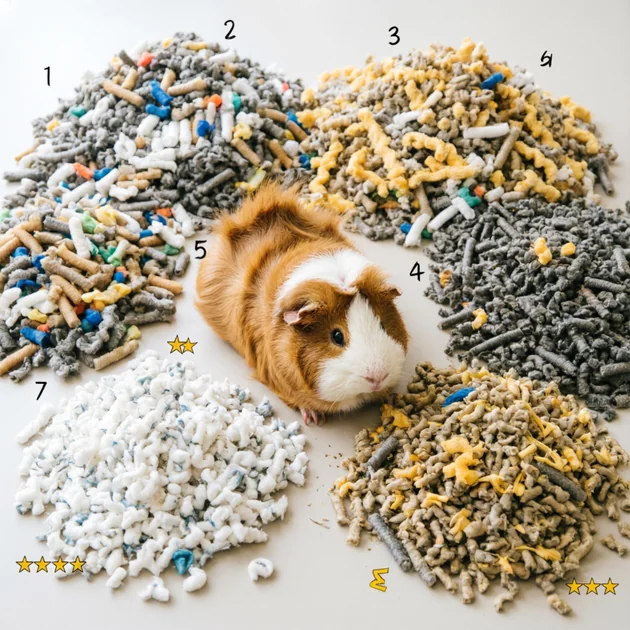
I’ve tried most of the bedding options on this list over the years, either for my own guinea pigs or through helping other owners set up their cages. Bedding is one of those decisions that seems minor but ends up affecting your daily life significantly — you’ll be cleaning, replacing, and dealing with this stuff every single week, so getting it right matters more than you’d think.
This guide covers the seven bedding options I’d actually recommend, ranked by how well they work for most guinea pig owners. I’ve evaluated each on absorbency, odor control, comfort, dust levels, and long-term value. Your priorities might differ depending on your budget, how many pigs you have, and whether anyone in your household has respiratory sensitivities.
For a deeper dive into specific bedding types, see our guinea pig bedding guide, fleece bedding guide, and bedding options comparison.
How I Evaluate Bedding
Before getting into specific products, here’s what I’ve found actually matters in practice:
Absorbency is the most important factor. Guinea pigs produce a surprising amount of waste — a pair can go through several cups of urine daily. Bedding that can’t keep up means wet patches, odor, and potential skin infections. Paper-based bedding and hemp are the most absorbent options I’ve tested.
Dust level matters more than most people realize. Guinea pigs have sensitive respiratory systems, and dusty bedding can cause sneezing, wheezing, and chronic respiratory issues. I’ve seen pigs improve dramatically after switching from dusty wood shavings to low-dust alternatives. If anyone in your household has asthma or allergies, this should be your top priority. Even if you don’t have respiratory concerns, reducing dust exposure is always better for your guinea pig’s long-term health. I always open a new bag of bedding and give it a sniff test — if it makes me want to sneeze, it’s too dusty for my pigs.
Odor control varies enormously between bedding types. Some options (like hemp) naturally suppress odors for days, while others need to be changed every few days to stay fresh. Ammonia buildup from urine isn’t just smelly — it’s harmful to your guinea pig’s respiratory tract.
Comfort affects your guinea pig’s feet and skin. Paper bedding and fleece are the softest options. Wood shavings and pellets can be rougher, though aspen is reasonably comfortable. I’ve noticed that guinea pigs on softer bedding tend to be more active and spend less time huddled in one spot. Wire mesh floors are never acceptable — they cause a painful condition called bumblefoot that requires veterinary treatment and can become chronic. If your cage has wire flooring, cover it with coroplast, acrylic, or a thick layer of bedding immediately.
Long-term cost is where most owners get surprised. Fleece has the highest upfront cost but saves hundreds per year since it’s reusable. Disposable bedding costs add up fast — I’ve calculated that a typical 2x4 C&C cage goes through $40-60/month in paper bedding. Over a guinea pig’s 5-8 year lifespan, that’s $2,400-$5,760 in bedding alone. Fleece, by contrast, costs $100-150 upfront for 2-3 sets and roughly $5-10/month in laundry costs. The math is pretty compelling once you look at it annually.
Carefresh Natural Paper Bedding
Carefresh Paper Bedding | ~$18.99 for 85L
If I had to pick just one bedding for a new guinea pig owner, it would be Carefresh Natural. It’s made from 100% recycled paper, is 99.9% dust-free, absorbs roughly twice as much as wood shavings, and is safe if ingested (which matters — guinea pigs sometimes taste their bedding).
I’ve used Carefresh in multiple cages and it consistently performs well. The texture is soft and fluffy, which guinea pigs seem to enjoy walking and resting on. Odor control is good but not exceptional — I find I need to do spot cleaning every 2-3 days and a full change weekly. At roughly $40-60/month for a standard 2x4 cage, it’s not the cheapest long-term option, but the convenience and reliability are hard to beat.
The main downside is the ongoing cost and waste. If you have multiple cages or large enclosures, the monthly expense adds up quickly. The used bedding also creates a lot of waste — I fill roughly one kitchen bag per cage per week with soiled paper bedding. Composting is an option if you have a garden (guinea pig waste from paper bedding makes excellent compost), but not everyone has that option. For most single-cage owners, Carefresh hits the sweet spot of performance and convenience despite the recurring cost.
Best for: First-time owners, guinea pigs with respiratory sensitivities, anyone who wants a reliable no-fuss option.
Aubiose Hemp Bedding
Hemp bedding is the option I recommend most often for owners dealing with odor problems. Aubiose hemp bedding has natural antibacterial properties that suppress ammonia odor far better than paper or wood-based options. In my experience, a hemp-bedded cage stays fresh noticeably longer between cleanings.
Hemp is extremely absorbent — it holds several times its weight in liquid — and breaks down into a soft, comfortable texture. It’s also naturally low in dust and doesn’t contain the aromatic oils that make pine and cedar dangerous. The environmental footprint is excellent since hemp grows quickly and requires minimal processing.
The downside is availability and cost. Hemp bedding can be harder to find than paper or wood options (I usually order online), and it’s priced at a premium. It also doesn’t have the fluffy, pillowy texture of paper bedding — some owners and guinea pigs prefer the softer feel of Carefresh or similar products.
Best for: Multiple guinea pig households, owners prioritizing odor control, anyone willing to order online for better performance.
GuineaDad Fleece Liners
GuineaDad Fleece Liner | Premium price
Fleece liners are the bedding I personally use for my own guinea pigs, and the GuineaDad liners are the best I’ve tested. They have a built-in absorbent layer and waterproof backing, which means you don’t need a separate underpad — just lay the liner down and you’re set.
The long-term economics are compelling. A set of GuineaDad liners costs more upfront than a bag of paper bedding, but they’re reusable for years. I’ve calculated savings of $300-500 per year compared to disposable options. You do need 2-3 sets to rotate while washing, which increases the initial investment.
The trade-off is maintenance. Fleece requires washing every 2-3 days, which means regular laundry. You also need to sweep or shake off debris (hay, poop) daily — a handheld vacuum makes this much easier. Some guinea pigs enjoy digging and bunching up fleece, which can expose the waterproof bottom layer. If your pig is a digger, adding corner weights or using larger liners that tuck under the cage walls helps significantly. I also recommend putting a hay rack above a litter box area to catch dropped hay before it ends up on the fleece.
For guinea pigs with respiratory issues, fleece is the clear winner — zero dust, zero particles, zero aromatic oils. It’s also the most comfortable option for feet and skin.
For detailed fleece setup and maintenance instructions, see our fleece bedding guide.
Best for: Long-term owners wanting to save money, guinea pigs with respiratory issues, anyone willing to do regular laundry.
Small Pet Select Aspen Bedding
Aspen is the safe wood option — unlike pine and cedar, aspen doesn’t contain toxic phenols that cause respiratory damage. Small Pet Select’s aspen is kiln-dried to reduce dust further, and it has a pleasant natural wood scent without being overpowering.
I find aspen works well as a base layer under paper bedding or fleece. On its own, it’s less absorbent than paper or hemp, and it can be a bit rougher on guinea pig feet. The small particle size means it gets tracked outside the cage more easily than larger-chip options.
At a moderate price point, aspen sits in the middle of the cost spectrum. It’s cheaper than premium paper bedding but more expensive than basic pine pellets. For owners who prefer natural materials and want something safer than pine or cedar, it’s a solid choice.
Best for: Owners who prefer natural wood bedding, use as a base layer under other materials.
Kaytee Clean & Cozy Paper Bedding
Kaytee Clean & Cozy | ~$15-20 for 49.2L
Kaytee Clean & Cozy is the budget-friendly paper option that I’d recommend over cheaper wood-based alternatives. It’s made from paper fibers that are processed to be soft and absorbent, with minimal dust. It’s not quite as plush or absorbent as Carefresh, but it performs respectably for the price.
I’ve found that Kaytee bedding compacts more than Carefresh over time, which means you might need to add more frequently or do full changes slightly more often. The odor control is adequate but not outstanding — I’d plan for spot cleaning every 2 days with a full change every 5-6 days.
At the lower price point, Kaytee is a practical choice for owners with multiple cages or tight budgets who still want a paper-based product. Just don’t expect it to last quite as long between changes as the premium options.
Best for: Budget-conscious owners, multi-cage households, anyone wanting paper bedding at a lower price.
Pine Pellets (Equine or Stove Pellets)
Pine pellets are the most economical bedding option I’ve found, and they work surprisingly well. The pellets are made from compressed pine sawdust that’s been heat-treated to remove the harmful phenolic oils. When they get wet, they expand and break down into a soft, absorbent material. This expansion process is actually part of the appeal — you can hear when the pellets have absorbed urine because they crumble apart, making it easy to spot-clean just the wet areas.
The economics are hard to beat — a 40-pound bag of equine pine pellets typically costs $6-10 and lasts weeks in a standard cage. I’ve seen owners cut their bedding costs to under $10/month with pine pellets. You can find them at feed stores, tractor supply shops, and online. The key is making sure you’re getting heat-treated pellets, not plain pine shavings.
The downsides: pine pellets can be dusty when first poured (though they settle quickly), the initial texture is hard before they break down, and some guinea pigs don’t like walking on the harder pellets. I’d recommend adding a layer of softer bedding on top, or spraying the pellets lightly with water before adding them to jump-start the expansion process.
Pine pellets work especially well in litter boxes underneath fleece liners — the pellets absorb urine while the fleece provides a comfortable surface.
Best for: Budget-conscious owners, use as litter box substrate under fleece, large enclosures where cost matters.
Oxbow Pure Comfort Bedding
Oxbow Pure Comfort Bedding | Premium price
Oxbow is a brand I trust for small pet products, and their Pure Comfort bedding is consistent with that quality. It’s a paper-based product that’s soft, absorbent, and virtually dust-free. Performance is comparable to Carefresh — some owners prefer one, some the other.
I’d put this in the premium category both in quality and price. It’s an excellent bedding that does everything well, but it doesn’t offer a clear advantage over Carefresh to justify the typically higher price. I’d recommend it if you find it on sale or if you already feed Oxbow products and want to stick with one brand.
Best for: Owners who prefer the Oxbow brand, situations where it’s priced competitively with Carefresh.
Quick Comparison
| Bedding | Absorbency | Odor Control | Comfort | Dust | Monthly Cost* |
|---|---|---|---|---|---|
| Carefresh | Excellent | Good | Excellent | Very Low | $40-60 |
| Hemp (Aubiose) | Excellent | Excellent | Good | Very Low | $30-50 |
| GuineaDad Fleece | N/A (washable) | Good (with washing) | Excellent | Zero | $5-10 (laundry) |
| Small Pet Select Aspen | Good | Fair | Fair | Low | $25-40 |
| Kaytee Clean & Cozy | Good | Fair | Good | Low | $30-45 |
| Pine Pellets | Good | Good | Fair (improves when wet) | Medium | $8-15 |
| Oxbow Pure Comfort | Excellent | Good | Excellent | Very Low | $45-65 |
*Estimated for a standard 2x4 C&C cage with 2 guinea pigs.
How to Choose Based on Your Situation
Single guinea pig: Any option works well. I’d start with Carefresh for simplicity.
Multiple guinea pigs: Hemp or fleece. More pigs means more waste, and these options handle it best.
Small apartment: Hemp or paper bedding. Fleece requires laundry access, which might be inconvenient in an apartment building.
Tight budget: Pine pellets, possibly layered under fleece for the best of both worlds.
Respiratory issues: Fleece, no question. Zero dust, zero particles.
First-time owner: Carefresh. It’s the most forgiving and easiest to use — you can’t really go wrong with it.
Long-term owner: Fleece. The savings add up significantly over time, and the reduced waste is better for the environment. The laundry commitment becomes routine after a few weeks.
What about sensitive skin? If your guinea pig has bald spots, redness, or scabs on their feet or belly, the bedding might be the cause. Rough wood shavings can irritate skin, and wet bedding promotes fungal infections. I’d switch to fleece immediately if you notice any skin issues, and consult your exotic vet if the problem doesn’t resolve within a week.
What about allergies? If you’re allergic to your guinea pig (more common than people think), the bedding can make it worse. Paper bedding and fleece produce the least allergen exposure. Dusty wood shavings are the worst option for allergy sufferers. I’ve met owners who thought they were allergic to their pigs but were actually reacting to dusty bedding — the problem disappeared after switching to fleece.
FAQ
What’s the most important thing to look for in bedding?
Absorbency and dust level. Your guinea pig will be in contact with this material 24/7. If it can’t absorb urine effectively, your pig sits in wet conditions that cause skin infections. If it’s dusty, it irritates their respiratory system. Everything else is secondary.
Can I mix different beddings?
Yes, and many experienced owners do. A common combination is pine pellets in the litter box area with fleece over the rest of the cage. Another approach is aspen or paper as a base layer with a softer material on top. The key is making sure all materials are safe — no pine shavings (only heat-treated pellets), no cedar, and no sawdust.
I’ve personally used a pine pellet-and-fleece combination for years and it works beautifully. The pellets go in a large litter box (guinea pigs can be litter trained — see our guinea pig care guide for tips), and the fleece covers the rest of the cage floor. This setup combines excellent odor control (from the pellets) with comfort (from the fleece) while keeping costs reasonable.
How often should I change bedding?
It depends on the type. Paper bedding: full change every 5-7 days with daily spot cleaning. Hemp: similar to paper but often stretches to 7-10 days. Fleece: wash every 2-3 days, spot clean daily. Pine pellets: spot clean daily, full change every 1-2 weeks.
I’ve found that the best indicator isn’t a fixed schedule — it’s your nose. If you can smell ammonia when you walk into the room, you’ve waited too long. Guinea pigs have much more sensitive respiratory systems than we do, so by the time you can smell it, the air quality is already poor for them. I change bedding a day before I think I need to.
What about using newspaper or shredded paper?
Plain newspaper (black and white only, no colored pages) is safe in a pinch, but it’s not absorbent enough for long-term use. It compacts quickly and starts smelling within a day or two. Shredded office paper has similar problems plus potential issues with inks and chemicals. I’d only use these as temporary solutions.
My guinea pig is eating their bedding. Is that normal?
Guinea pigs occasionally nibble on their bedding, especially when they’re bored or hungry. Small amounts of paper or aspen are generally harmless. However, if your guinea pig is eating large quantities, it could indicate a dietary deficiency (not enough hay) or boredom (not enough enrichment). Make sure hay is always available and that your pig has enough chew toys and tunnels to keep them occupied.
Is expensive bedding worth it?
Sometimes. Hemp bedding costs more per bag but lasts longer between changes, which can make it cheaper per week. Fleece has the highest upfront cost but the lowest long-term cost. Cheap wood shavings (non-aspen) are the worst value because they need frequent changes and can cause health problems that cost far more than better bedding.
What bedding saves the most money long-term?
Fleece liners, hands down. The initial investment in 2-3 sets of quality liners is higher than a bag of paper bedding, but you eliminate the ongoing $40-60/month cost. I’ve calculated savings of $300-500 per year with fleece. Pine pellets are the cheapest disposable option at roughly $8-15/month.
Conclusion
After testing these options extensively, here’s my honest recommendation: start with Carefresh Natural if you’re a new owner — it’s reliable, safe, and easy to use. If you’re dealing with odor issues, switch to hemp. If you’re committed for the long term and want to save money, invest in GuineaDad fleece liners.
Whatever you choose, avoid cedar shavings entirely (toxic), pine shavings (contain harmful oils — pellets are fine), sawdust (respiratory hazard), and clay cat litter (dusty and dangerous if ingested). I also avoid corn cob bedding — it molds quickly when wet and can cause intestinal blockages if eaten. Your guinea pig spends their entire life on their bedding — it’s worth getting right.
One final thought: the best bedding in the world won’t help if your cage is too small. Overcrowding accelerates waste buildup and makes any bedding struggle to keep up. Make sure your enclosure meets minimum size requirements (at least 7.5 sq ft for one pig, 10.5 sq ft for a pair — more is better). See our guinea pig cage size guide for specific recommendations.
For more detailed information on specific bedding types and setup techniques, explore our full guinea pig bedding guide.