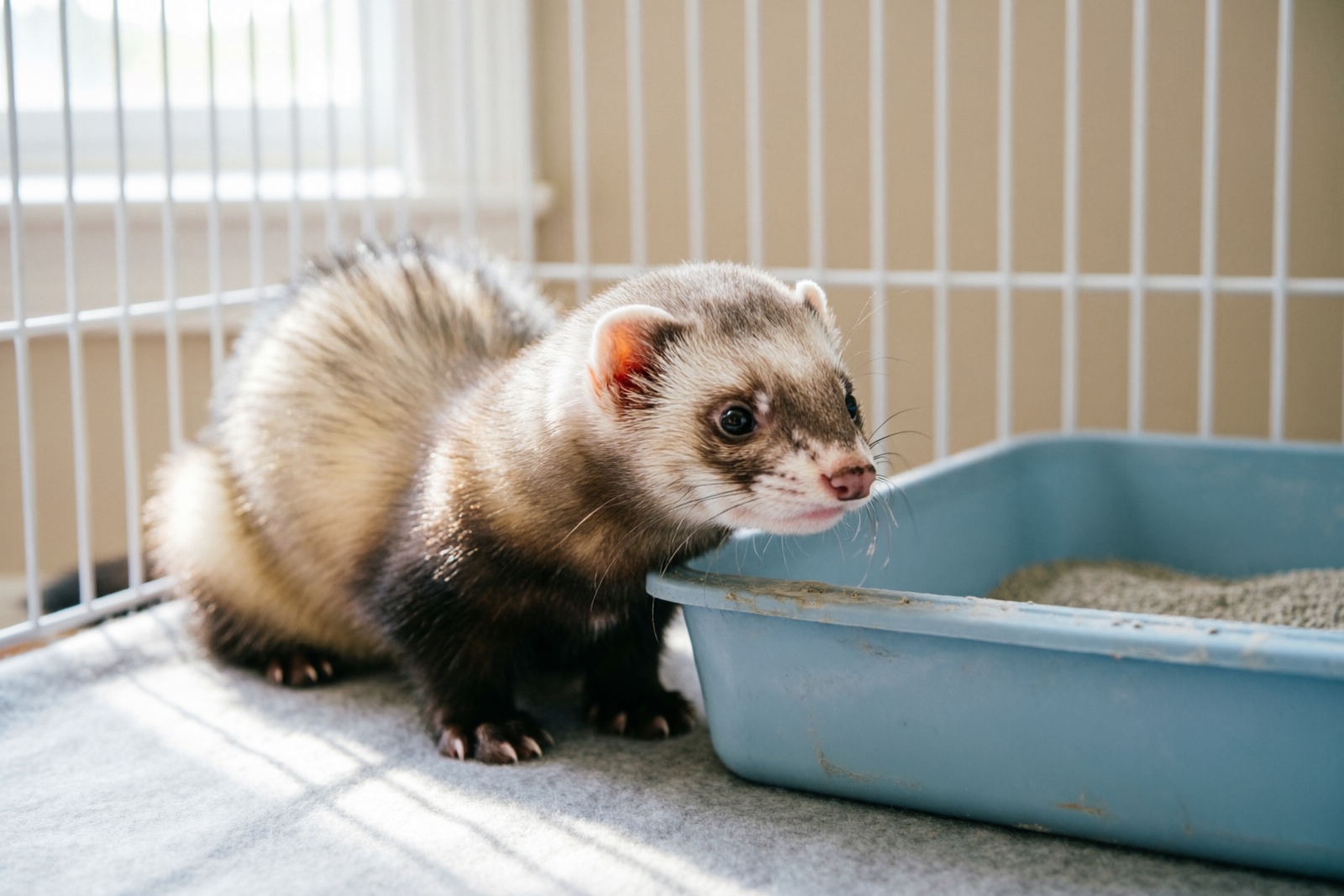
Yes, ferrets can be litter trained — but unlike cats, they won’t achieve 100% perfection. Most ferrets learn to use a litter box within their cage within 2-4 weeks, but may have occasional accidents during free-roam time. Understanding what to expect and having the right supplies makes the process significantly smoother.
The secret to success is working with your ferret’s natural instincts. Ferrets almost always back into corners to eliminate. They rarely go in the middle of an open space. Once you understand this pattern and provide appropriate corner litter boxes with the right litter, training becomes much more straightforward. The real challenge is extending cage-trained behavior to free-roam areas outside the cage.
Proper ferret litter training matters for several reasons: it reduces cleaning time and odor, makes it easier to monitor stool health (which is an important ferret health problems indicator), and protects your furniture and flooring. This guide is an essential part of overall ferret care that makes sharing your home with a ferret far more pleasant.
Can Ferrets Be Litter Trained?
What to Expect
Ferrets are moderately easy to litter train — easier than rabbits, harder than cats. Most ferrets learn basic litter box use in 2-4 weeks, but full reliability may take 2-3 months. Older ferrets generally train faster because they already have established bathroom habits. Young kits (under 12 weeks) need more patience and consistency — their attention spans are short and they may not yet have full bladder control.
The key insight: ferrets naturally prefer to back into corners to eliminate. Ferret litter training works by placing a litter box in the corners they’ve already chosen — not by forcing them into a location you prefer. If you work with their instinct rather than against it, training becomes straightforward. A ferret that has chosen a corner will almost always use a box placed in that same corner within days.
Some ferrets will use a litter box 90% of the time, while others hover around 70%. Neither result is “failure” — occasional accidents during free-roam time are normal and expected even in well-trained ferrets. The goal is consistency within the cage and reasonable compliance outside.
Why Litter Training Matters
Beyond cleanliness and odor control, a litter-trained ferret is easier to monitor for health purposes. Changes in stool frequency, color, or consistency are early warning signs of illness that are easy to miss when a ferret eliminates randomly around your home. A designated litter box makes these changes immediately visible.
Healthy ferret stool should be dark brown, formed, and relatively odorless. Loose, green, black, or bloody stool requires immediate veterinary attention. When your ferret uses a consistent litter box, you can spot these changes within hours rather than days.
Best Litter Boxes for Ferrets — What to Look For
3 Must-Have Features
- High back walls — Ferrets back up into corners and “spray” urine backward. Without a high back, you’ll constantly be wiping urine off the wall behind the litter box.
- Corner shape — Matches the ferret’s natural instinct to eliminate in corners. Corner boxes also save cage space.
- Low front entry — Makes it easy for ferrets (especially kits and older ferrets) to hop in and out without effort.
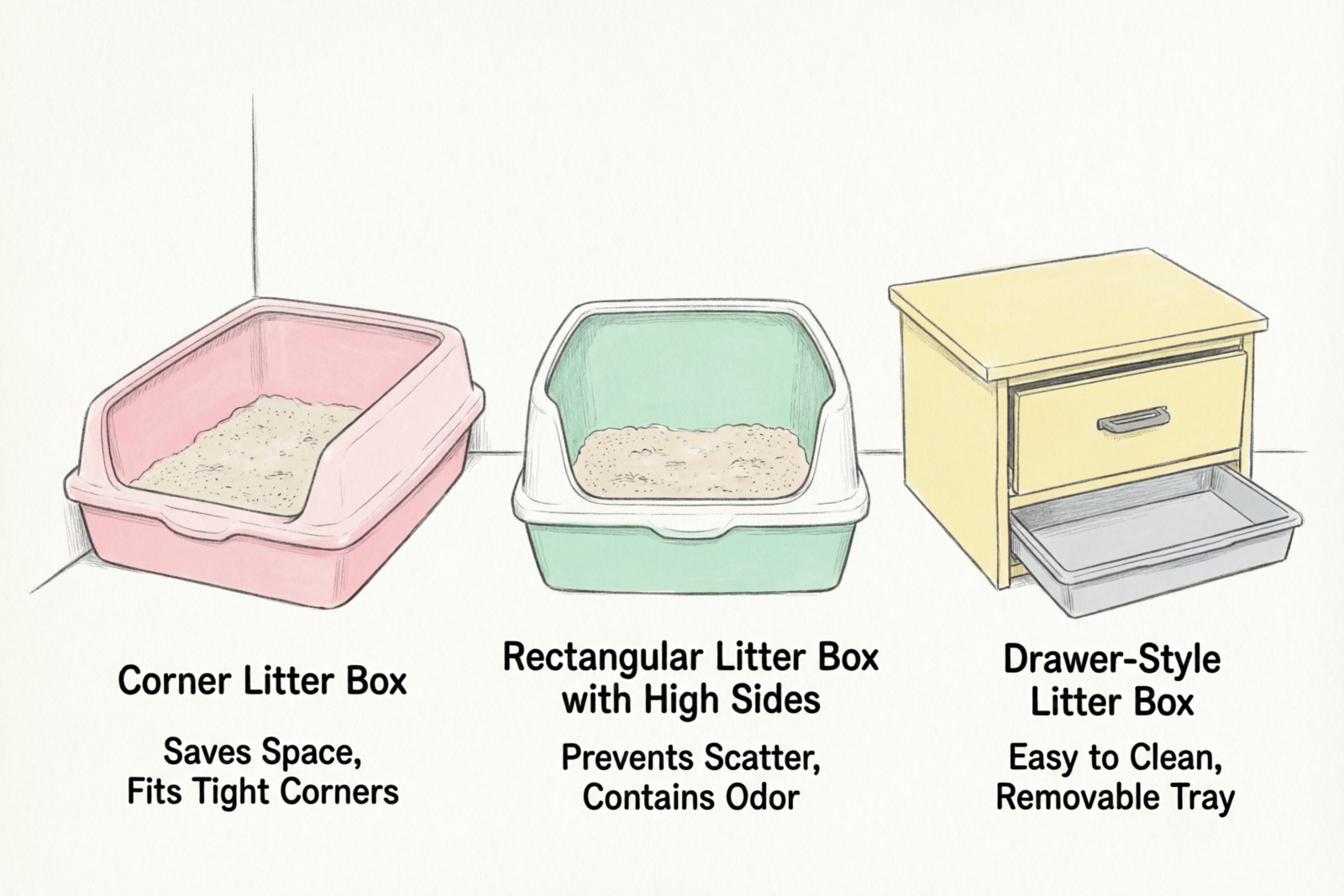
Corner vs Rectangle vs Drawer Litter Boxes
| Type | Pros | Cons | Best For |
|---|---|---|---|
| Corner box | Saves space, matches instinct | Smaller capacity | Standard cage setup |
| Rectangle box | Larger capacity, fits multiple ferrets | Takes more space | Large cages / free-roam |
| Drawer box | Daily cleaning without removing box | Higher price, larger footprint | Convenience seekers |
For most ferret owners, a corner box inside the cage plus one or two additional boxes in play areas provides the best coverage. The right ferret cage setup should accommodate at least one litter box per level in multi-level cages. A large ferret cage provides room for multiple boxes without sacrificing living space.
Lixit Corner Litter Pan — Classic Choice
Lixit Corner Litter Pan for Ferrets ($12.99, 4.5⭐)
This is the litter pan I’ve seen in more ferret cages than any other. The corner design fits standard cage corners perfectly, and the low front entry makes it easy for ferrets of all sizes to access. Durable plastic resists chewing and is simple to clean. At $12.99, it’s affordable enough to buy multiple for multi-level cages.
The main drawback is that it has no attachment mechanism — some ferrets push it around, which can be frustrating. I’ve seen owners secure it with zip-ties through the cage bars, which solves the problem. For most cages, though, the weight of the litter keeps it in place.
Ware Lock-N-Litter Pan (2 Pack) — Won’t Get Tipped
Ware Lock-N-Litter Pan (2 Pack) ($22.35, 4.2⭐)
The lock-n-latch design clips directly to cage wires, preventing ferrets from tipping or moving the box — a common frustration with unsecured pans. The 2-pack at $22.35 is excellent value for multi-level cages where you need boxes on each level.
I’d recommend this if your ferrets are persistent litter box pushers. The latches may not fit all bar spacing, though, so check your cage measurements before buying. The design is also somewhat shallow, which can lead to litter being kicked out.
BWOGUE Large Corner Litter Box with Drawer — Easiest Cleaning
BWOGUE Large Corner Litter Box with Drawer ($25.49, 4.4⭐)
The drawer design is genuinely useful — pull out the bottom tray, empty it, and push it back in without removing the entire box from the cage. A mesh floor insert keeps ferrets’ feet clean by separating them from soiled litter. The larger size comfortably accommodates adult ferrets.
At $25.49, it’s more expensive than the basic options, and the larger footprint may not fit smaller cages. But if you value cleaning convenience — and you will, since you’ll be cleaning this daily — the drawer design is worth the extra cost.
Best Litter for Ferrets — Types Compared
Safe Litter Types
| Litter Type | Pros | Cons | Rating |
|---|---|---|---|
| Paper pellet | High absorption, low dust, safe if ingested | More expensive | ⭐⭐⭐⭐⭐ |
| Wood pellet | Cheap, high absorption, good odor control | Can be dusty | ⭐⭐⭐⭐ |
| Recycled paper bedding | Strong absorption, good odor control | May have light dust | ⭐⭐⭐⭐ |
| Clay litter | ❌ NEVER use | Dusty, sticks to fur, dangerous if ingested | ❌ |
❌ Never Use These
- Clumping clay litter — Dust damages ferret respiratory systems, clumps stick to fur and can cause intestinal blockages if ingested during grooming
- Pine or cedar shavings — Contain volatile oils (phenols) that are toxic to ferrets, causing liver and respiratory damage
- Scented litter — Chemical fragrances irritate ferret airways
- Corn cob bedding — Mold risk and intestinal blockage if ingested
Small Pet Select Recycled Paper Pellet Litter
Small Pet Select Recycled Paper Pellet Litter (10lb) ($26.51, 4.5⭐)
This is the litter I’d recommend for ferrets. It’s 99% dust-free, made from 100% recycled paper with no pine or cedar oils — safe for ferret respiratory systems even with daily exposure. It absorbs moisture effectively and controls odor well. The trade-off is cost: it’s more expensive per pound than wood pellets, and it breaks down faster, needing more frequent changes.
Vitakraft Fresh World Ultra Strength Bedding
Vitakraft Fresh World Ultra Strength Bedding (16L) ($39.98, 4.6⭐)
The ultra-strength formula is 3x more absorbent than standard bedding — it expands when wet to lock in moisture and odors. The 16L bag provides excellent value for multi-ferret households. No pine or cedar oils, safe for ferrets. It can be dusty — I’d shake the bag before using to reduce loose dust. It’s also heavier than paper alternatives.
Step-by-Step Ferret Litter Training Guide
Phase 1: Cage Training (Week 1-2)
Start inside the cage where you can control the environment:
- Observe which corner your ferret chooses — Before placing any litter box, watch where your ferret naturally eliminates. They almost always pick a corner
- Place the litter box in that corner — Never force a different location. Working with their instinct is faster than working against it
- Add scent cues — Place a few soiled litter pellets or a small amount of used bedding in the new box. Ferrets use scent to locate their bathroom
- Place your ferret in the box after waking — Ferrets typically need to eliminate within 10-15 minutes of waking up. Pick them up and gently place them in the litter box during this window
- Reward success immediately — When your ferret uses the box, offer a treat within seconds. Ferrets respond well to positive reinforcement
- Clean accidents with enzyme cleaner — When accidents happen, use an enzyme-based cleaner to eliminate all trace odor. If a ferret can smell previous waste, they’ll return to that spot
Phase 2: Free-Roam Training (Week 3-4)
Once your ferret consistently uses the cage litter box, expand to free-roam areas:
- Place additional boxes in play areas — At least 2-3 boxes in the main free-roam space. One box per 10-15 square feet of floor space
- Line areas under boxes with training pads — During the training period, place pads under and around litter boxes to catch misses. Amazon Basics Training Pads (100 Count) ($17.45, 4.4⭐) offer good value at 100 pads for $17.45, with 5-layer construction for quick-dry absorption
- Watch for pre-elimination signals — Backing into a corner, sniffing the floor intently, and raising the tail. When you see these signs, gently pick up your ferret and place them in the nearest litter box
- Gradually remove unnecessary boxes — After 2-3 weeks, remove boxes that aren’t being used. Keep only the ones your ferret actively uses
Phase 3: Reinforcement (Week 5+)
- Continue rewarding correct litter box use with treats
- Clean all accidents with enzyme cleaner immediately — residual scent will attract your ferret back to the same spot
- Be patient — some ferrets take 2-3 months to become reliable. Consistency matters more than speed
Where to Place Litter Boxes — Cage & Play Area
Placement Rules
| Location | Recommendation | Reason |
|---|---|---|
| Cage corners | ✅ Essential | Ferrets naturally choose corners |
| Near food bowl | ❌ Avoid | Ferrets won’t eliminate where they eat |
| Each level of multi-level cage | ✅ Recommended | Ferrets won’t travel down to use a box |
| Free-roam play areas | ✅ Essential | 1 box per 10-15 sq ft |
| Semi-hidden corners | ✅ Ideal | Ferrets prefer some privacy |
The most common placement mistake is putting the litter box where it’s convenient for you rather than where the ferret wants it. If your ferret consistently eliminates in a specific corner, that’s where the box goes — even if it’s not your preferred location. You can gradually shift the box an inch per day toward a better spot, but never move it suddenly.
Check out our ferret cage ideas guide for layout examples that incorporate litter box placement effectively.
Common Litter Training Problems & Solutions
Problem-Solution Table
| Problem | Cause | Solution |
|---|---|---|
| Pooping outside the box | Wrong box location | Move box to the ferret’s preferred corner |
| Digging in litter | Natural instinct + boredom | Reduce litter depth; provide a dig box |
| Sleeping in the litter box | Box too large / no sleeping area | Use a smaller box; add a separate sleeping sack |
| Eating litter | Curiosity / dietary deficiency | Switch to paper pellets; review diet |
| Suddenly avoiding the box | Stress or illness | Rule out health issues first |
| Pooping at cage door | Box too far away | Add a box closer to the door |
When to See a Vet
A sudden change in litter box habits is often the first visible sign of illness. If your previously litter-trained ferret starts having frequent accidents, check for diarrhea, blood in stool, or unusual stool color. These can indicate gastrointestinal issues, adrenal disease, or other ferret health problems that require veterinary attention.
I’d also flag that if a ferret starts eliminating outside the box after months of consistent use, it’s worth a vet visit even if you don’t see obvious stool changes. Changes in bathroom habits can signal internal issues that aren’t visible to the naked eye — urinary tract problems, for example, can cause a ferret to avoid the box without any obvious external symptoms.
Digging in Litter — The #1 Frustration
Digging in litter is natural ferret behavior — wild ferrets dig in soil to eliminate and create burrows. Punishment doesn’t work and damages trust. Instead:
- Reduce litter depth to 1-2 inches — enough for absorption but not enough for satisfying digging
- Provide a separate dig box — A plastic bin filled with rice, clean sand, or safe packing peanuts gives your ferret an acceptable digging outlet
- Increase mental stimulation — Adequate ferret toys and sufficient out-of-cage playtime reduce boredom-driven behaviors
- Try a covered litter box — Some ferrets dig less when the box has a lid with an entry hole, though this doesn’t work for all individuals
Training Multiple Ferrets
If you have more than one ferret, expect the training process to take longer and be less consistent. Each ferret may prefer a different corner, which means you’ll need more boxes. I’d start by training each ferret individually in the cage, then work on free-roam training as a group. Some multi-ferret households find that one dominant ferret claims a box and others avoid it — providing multiple boxes in the same area can resolve this.
Ferrets that share a cage will sometimes establish a “community bathroom” in one corner. If this happens, work with it — place the largest box you can fit in that corner.
Cleaning & Maintenance Routine
Daily vs Weekly Routine
Consistency matters more than perfection. A quick daily scoop and thorough weekly clean keep odors manageable and your ferret willing to use the box.
| Frequency | Task | Tools |
|---|---|---|
| Daily | Scoop waste, spot-remove soiled litter, add fresh to maintain 1-2 inch depth | Small scoop |
| Weekly | Empty all litter, wash box with enzyme cleaner, dry completely, refill | Enzyme cleaner |
| Monthly | Deep disinfect box and surrounding cage area | White vinegar + water solution |
A clean litter box is the most important factor in maintaining training. Ferrets are fastidious — if the box is too dirty, they’ll find a cleaner corner instead.
Odor Control Tips
- Use enzyme-based cleaners that break down odor molecules rather than masking them — I’d look for a bleach-free formula safe for use around ferrets
- Never use bleach — the fumes irritate ferret respiratory systems and the scent discourages litter box use
- Avoid scented cleaners and air fresheners — chemical fragrances are harmful to ferrets
- Scoop daily — even one missed day can lead to a ferret refusing to use the box
- Keep litter depth at 1-2 inches — too little litter means odors aren’t absorbed; too much encourages digging and wastes litter
- Replace all litter weekly rather than just topping off — adding fresh litter on top of soiled layers concentrates ammonia in the bottom
- Ensure cage ventilation — poor airflow concentrates odors regardless of how clean the box is
FAQ: Ferret Litter Training Questions
Can ferrets be litter trained?
Yes. Most ferrets learn to use a litter box in their cage within 2-4 weeks. Free-roam reliability takes longer and may never be 100% — occasional accidents are normal. The key is placing boxes where the ferret wants to go, not where you want them to go.
How Long to Litter Train a Ferret?
Basic cage training: 2-4 weeks. Full free-roam reliability: 2-3 months. Older ferrets train faster; young kits need more patience. A consistent schedule and immediate cleaning of accidents are the biggest success factors.
What is the best litter for ferrets?
Paper pellet litter is the safest and most effective choice. Never use clumping clay litter, pine or cedar shavings, or scented products — all are dangerous to ferrets.
Why Do Ferrets Poop Everywhere?
The most common cause is incorrect box placement. Move the box to the corner where your ferret is eliminating. Other causes include a dirty box (scoop daily), stress from environmental changes, or underlying health issues.
Do ferrets need a litter box in their cage?
Yes. Ferrets won’t wait until they’re let out of their cage to eliminate. A cage litter box is essential — ideally one per level in multi-level setups.
How many litter boxes does a ferret need?
Minimum: one in the cage plus one in the main play area. For multi-level cages, one per level. For large free-roam spaces, one per 10-15 square feet. It’s better to have too many boxes than too few during training.
What cleaning products are safe for ferrets?
Enzyme-based cleaners are the safest option — they break down odor molecules without leaving chemical residues. I’d avoid bleach, ammonia-based products, and anything scented. A simple white vinegar and water solution (50/50 mix) works well for weekly deep cleaning. Always rinse thoroughly and let the box dry completely before refilling with litter.
My ferret was litter trained but started having accidents. What happened?
The most common causes in order of likelihood: the box is too dirty (scoop daily), something in the environment changed (moved the cage, new pet, different schedule), or an underlying health issue. Start by cleaning the box thoroughly, then check for environmental changes. If neither explains it, schedule a vet visit.
Ferret litter training is one of the first skills you’ll teach your pet, and it pays dividends for the entire life of your ferret. With the right litter box, safe litter, and consistent training, most ferrets become reliable within a few months.