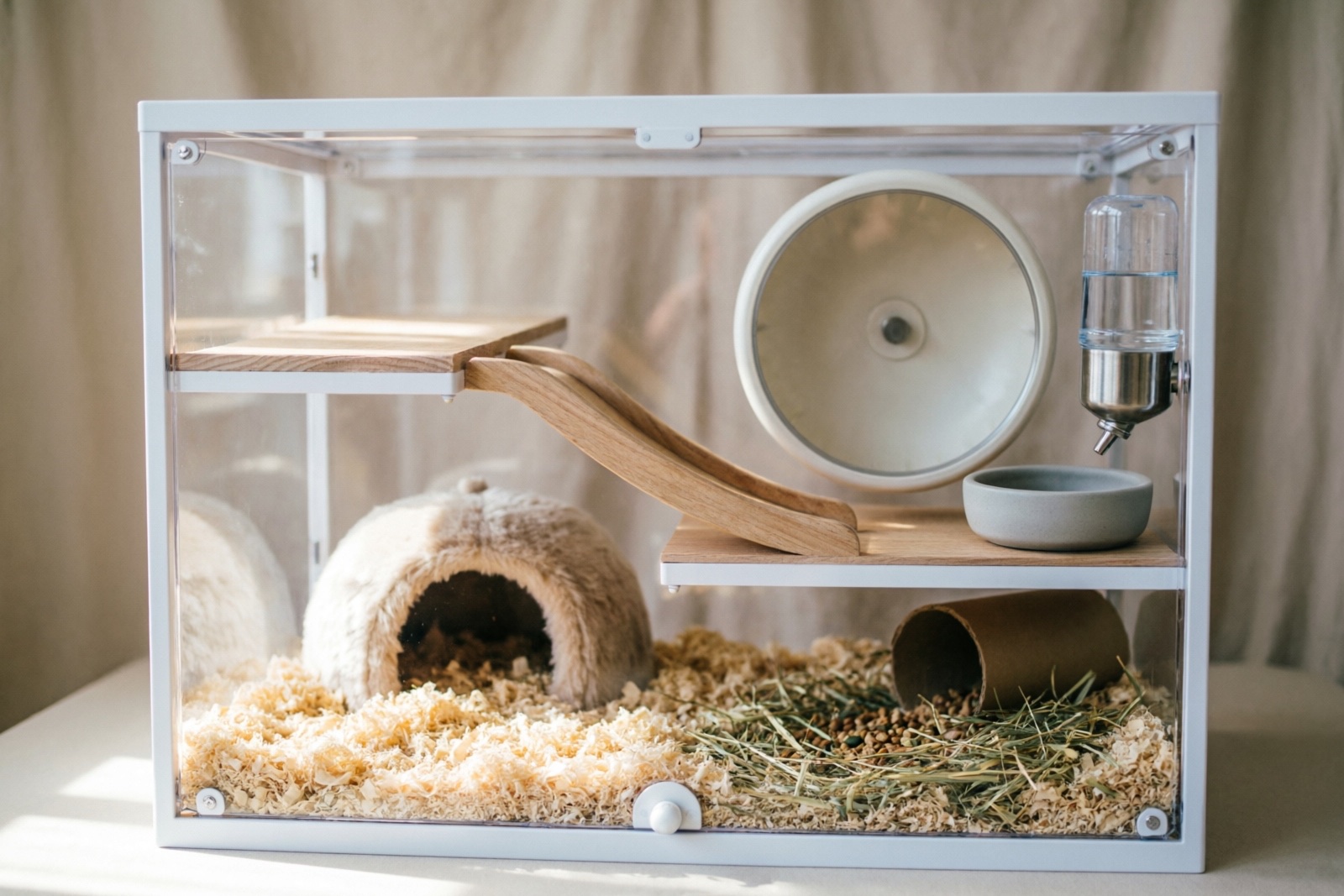
Setting up a proper cage for your hamster is the most important step in ensuring their health and happiness. Many new owners underestimate the space and enrichment hamsters need, leading to stressed and unhealthy pets. For a deep dive into enclosure requirements and what makes a proper hamster enclosure, check out our dedicated guide. This comprehensive guide will walk you through everything you need to create the perfect hamster habitat.
Why Proper Cage Setup Matters
Hamsters are active creatures that can run up to 5-6 miles per night in the wild [Journal of Mammalogy]. In captivity, they rely entirely on their cage environment for exercise, exploration, and mental stimulation. A poorly set up cage can lead to:
- Stress-related behaviors: Bar biting, cage climbing, excessive grooming — understanding hamster body language and behavior helps you spot stress early
- Health problems: Obesity, respiratory issues from poor bedding, injuries
- Reduced lifespan: Studies show enriched environments can extend hamster lifespan by 20-30% [Applied Animal Behaviour Science]. For more on how long hamsters live, see our hamster lifespan guide.
Minimum Cage Size Requirements
The 450 Square Inch Rule

The absolute minimum floor space for a hamster cage is 450 square inches (2,900 cm²) of unbroken floor space. This is the standard recommended by the Humane Society and multiple hamster welfare organizations [Hamster Welfare]. However, bigger is always better. Syrian hamsters especially benefit from larger enclosures:
- Minimum: 450 sq inches (61 x 30 inches)
- Recommended: 600+ sq inches
- Ideal: 800+ sq inches
Important: Cage size is measured by floor space, not total volume. Multi-level cages often have less usable floor space than single-level enclosures.
Species-Specific Requirements

| Hamster Type | Minimum Floor Space | Recommended | Bar Spacing |
|---|---|---|---|
| Syrian Hamster | 450 sq in | 600+ sq in | ≤ 0.5 inches |
| Dwarf Hamsters (Campbell’s, Winter White) | 400 sq in | 500+ sq in | ≤ 0.25 inches |
| Roborovski Hamster | 400 sq in | 600+ sq in | ≤ 0.25 inches |
| Chinese Hamster | 450 sq in | 600+ sq in | ≤ 0.25 inches |
For detailed Syrian hamster cage size guidance, see our Syrian hamster cage size guide. Different hamster breeds have different temperaments — learn more in our hamster breeds comparison guide.
Choosing the Right Cage Type

1. Glass Aquariums/Tanks (Recommended)
Pros:
- Easy to provide deep bedding (6-10 inches)
- No bar chewing
- Excellent visibility
- Great ventilation with mesh lid Cons:
- Heavy and difficult to move
- Can be expensive for large sizes
- Requires custom mesh lid Best Options:
- 40-gallon breeder tank (36” x 18” x 16”) - Our Top Pick
- 75-gallon tank (48” x 18” x 21”) Exo Terra 40 Gallon Screen Cover ($49.99, 4.6⭐, 🔥)
2. Bin Cages (Budget-Friendly)
Pros:
- Very affordable ($20-50)
- Lightweight and customizable
- Easy to modify with mesh windows Cons:
- Not as attractive as glass tanks
- Requires DIY modification
- Some plastics can warp over time Recommended: 110-quart storage bin with DIY mesh windows. For a full DIY tutorial, see our bin cage guide.
3. Wire Cages with Solid Base
Pros:
- Good ventilation
- Easy to attach accessories to bars
- Widely available Cons:
- Limited bedding depth
- Bar chewing risk
- Mess from kicking bedding out Avoid: Cages with wire floors (causes bumblefoot)
4. DIY Cage Builds
Pros:
- Completely customizable size
- Can be cost-effective for large enclosures
- Creative freedom Cons:
- Requires time and skills
- Materials can be expensive
- Must ensure proper ventilation
Essential Cage Components
1. Bedding (Depth: 6-10 inches minimum)
Hamsters are natural burrowers and need deep bedding to express this behavior. Safe Bedding Options:
- Paper-based bedding (Carefresh, Kaytee Clean & Cozy) - Most absorbent, low dust
- Aspen shavings - Natural, affordable, safe
- Hemp bedding - Sustainable, highly absorbent
- Birch shavings - Natural option (avoid cedar and pine) Avoid:
- ❌ Cedar shavings (causes respiratory issues)
- ❌ Pine shavings (phenols are harmful)
- ❌ Cotton bedding (impaction risk)
- ❌ Scented bedding Carefresh Paper Bedding ($18.99, 4.6⭐, 🔥)
2. Hideout/Shelter (Essential)
Hamsters need at least one multi-chamber hideout where they can feel secure. Features to look for:
- Multiple chambers (sleeping, nesting, food storage)
- Natural materials (wood, ceramic)
- Easy to clean
- Size appropriate for your hamster species Recommended Products:
- Niteangel Multi-Chamber Hideout ($15-20)
- Natural Cork Log ($10-15)
- Ceramic Hide House ($8-12)
3. Exercise Wheel (Critical)
Wheels are not optional - they’re essential for your hamster’s physical and mental health. Size Requirements:

- Syrian hamsters: 8-12 inches diameter
- Dwarf hamsters: 6.5-8 inches diameter Quality Features:
- Solid running surface (no mesh or rungs)
- Silent operation
- Stand or attachable to cage
- Appropriate width for hamster size
For more exercise ideas beyond the wheel, see our complete hamster exercise and fitness guide.
Top Recommendations:
- Niteangel Silent Wheel ($20-30)
- Trixie Exercise Wheel ($15-20)
- Wodent Wheel ($25-35)
4. Food Dish and Water Bottle
Food Dish:
- Ceramic or heavy plastic (prevents tipping)
- Shallow sides for easy access
- 2-3 inches in diameter Water Bottle:
- 4-8 oz capacity
- Glass or BPA-free plastic
- Check daily for leaks and blockages
- Position at appropriate height
5. Sand Bath
Sand baths allow hamsters to clean their fur and provide enrichment. Requirements:
- Use chinchilla sand or children’s play sand (not dust)
- Container size: 6” x 6” minimum
- Depth: 1-2 inches
- Replace sand weekly or when soiled
Enrichment and Accessories
Tunnels and Tubes
Hamsters love exploring tunnels, which mimic their natural burrow systems. Options:
- PVC pipes (3-4 inch diameter)
- Cardboard tubes (free!)
- Wooden bridges
- Commercial tunnel systems
Chew Toys
Hamster teeth never stop growing, so chewing is essential. Safe Options:
- Untreated wood blocks
- Apple wood sticks
- Willow balls
- Natural loofah
Climbing Structures
While hamsters are primarily ground-dwellers, they enjoy climbing opportunities. Safe Climbing Options:
- Wooden ladders
- Grapevine wood
- Cork bark
- Low platforms (6 inches or less in height)
Foraging Opportunities
Our hamster toys & enrichment guide covers the best options for keeping your hamster stimulated. Make your hamster work for their food to provide mental stimulation. Ideas:
- Scatter feeding
- Puzzle feeders
- Hide treats in bedding
- Toilet paper tube feeders
For more cage enrichment ideas and setup inspiration, check out our dedicated guide.
Temperature and Location
Ideal Temperature Range
- Optimal: 65-75°F (18-24°C)
- Danger zone: Below 50°F or above 80°F
- Hamsters can enter torpor (hibernation-like state) if too cold
Cage Placement
DO:
- ✅ Place in a quiet area
- ✅ Maintain consistent temperature
- ✅ Ensure good ventilation
- ✅ Keep away from direct sunlight DON’T:
- ❌ Place near windows (temperature fluctuations)
- ❌ Put in direct sunlight
- ❌ Position near air vents
- ❌ Keep in high-traffic areas
- ❌ Place near other pets
Setting Up Your Cage: Step-by-Step
Step 1: Clean the Cage
Before setting up, clean the cage with a pet-safe disinfectant or vinegar-water solution (1:1 ratio). Rinse thoroughly and dry completely.
Step 2: Add Bedding

Pour bedding to a depth of at least 6 inches across the entire floor. Create deeper areas (8-10 inches) in corners for burrowing. Pat down lightly.
Step 3: Place Hideout
Position the main hideout in a quiet corner, preferably where your hamster can observe their surroundings while feeling secure.
Step 4: Install Wheel
Place the wheel on a flat, stable surface. For wire cages, attach securely to bars. For tanks, use a wheel with a stable stand.
Step 5: Add Food and Water
- Position food dish away from the toilet area (hamsters usually pick one corner)
- Attach water bottle at appropriate height - hamster should be able to reach without stretching
Step 6: Create Enrichment Zones

- Sand bath in one corner
- Chews near hideout entrance
- Tunnels leading to different areas
- Foraging spots throughout
Step 7: Temperature Check

Verify the location maintains proper temperature range before introducing your hamster.
Cleaning and Maintenance
Daily Tasks
- Remove soiled bedding from toilet corner
- Check water bottle for leaks/blockages
- Remove any fresh food after 4-6 hours
- Spot clean wet bedding
Weekly Tasks
- Replace 25-50% of bedding
- Clean food dish and water bottle
- Wash sand bath container and replace sand
- Wipe down cage surfaces
Monthly Tasks
- Full cage clean (replace all bedding)
- Deep clean all accessories — this is also a good time for nail trimming if your hamster’s nails are getting long
- Inspect for wear/damage
- Check wheel for proper function
Pro Tip: Don’t clean the entire cage too frequently - this removes your hamster’s scent and causes stress. Spot cleaning is usually sufficient.
Common Setup Mistakes to Avoid
Poor cage setup can lead to serious hamster health problems — here are the most common mistakes.
1. Cage Too Small
The #1 mistake new owners make. If you’re unsure, always go bigger.
2. Shallow Bedding
Hamsters need to burrow - 2 inches of bedding is not enough.
3. Wire Floors
Never use wire flooring - causes bumblefoot (painful foot infections).
4. Wrong Wheel Size
Too-small wheels cause back problems and discourage use.
5. Lack of Hideouts
Hamsters need privacy - multiple hideouts reduce stress.
6. Overcrowding
Don’t fill the cage with so many accessories that there’s no room to move.
7. Dangerous Materials
Avoid cedar, pine, cotton, and any painted/treated wood.
Budget Breakdown
Here’s what you can expect to spend on a proper setup:
| Item | Budget Option | Quality Option | Premium Option |
|---|---|---|---|
| Cage | Bin cage ($30) | 40-gal tank ($100) | Custom build ($200+) |
| Bedding (initial) | Aspen ($10) | Paper-based ($20) | Hemp ($25) |
| Wheel | Basic ($10) | Silent ($25) | Premium ($35) |
| Hideout | Ceramic ($8) | Multi-chamber ($20) | Natural wood ($30) |
| Accessories | DIY/PVC ($10) | Commercial ($30) | Premium ($50+) |
| Total | $68 | $195 | $340+ |
Product Recommendations
Complete Starter Kit
For new owners, we recommend this setup:
- Cage: 40-Gallon Breeder Tank ($80-100)
- Available at PetSmart/PetCo (not sold on Amazon)
- Bedding: Kaytee Clean & Cozy ($30 for 100L)
- Wheel: Niteangel Super-Silent Wheel ($35-38)
- Hideout: Niteangel Multi-Chamber House ($28-32)
- Sand Bath: Exo Terra Desert Sand ($14-16)
- Buy on Amazon - $14.99 Total Cost: ~$150-180
FAQ
Q: How often should I clean my hamster’s cage?
A: Spot clean daily (remove soiled bedding), partial clean weekly (replace 25-50% bedding), and full clean monthly. Avoid cleaning too frequently as it removes your hamster’s scent and causes stress.
Q: Can I use pine or cedar bedding?
A: No! Both contain phenols that cause respiratory damage and liver problems. Stick to aspen, paper-based, or hemp bedding.
Q: How deep should the bedding be?
A: Minimum 6 inches across the entire cage, with deeper areas (8-10 inches) for burrowing. Syrian hamsters especially benefit from deeper bedding.
Q: Do hamsters need light at night?
A: No. Hamsters are crepuscular/nocturnal and prefer dim or dark conditions during their active hours. Maintain a natural day/night cycle.
Q: Can hamsters live together?
A: Syrian hamsters are strictly solitary and must live alone. Some dwarf species can cohabitate, but it requires careful introduction and monitoring. Always have a backup cage ready.
Q: Why is my hamster bar biting?
A: Bar biting is usually a sign of stress, boredom, or too-small cage size. Increase cage size, add enrichment, and provide more bedding for burrowing.
Q: What temperature should I keep the cage at?
A: 65-75°F (18-24°C) is ideal. Avoid temperature fluctuations and never let it drop below 50°F or rise above 80°F.
A proper cage setup pairs perfectly with good nutrition — see our complete hamster diet guide for feeding tips.
Conclusion
Creating the perfect hamster habitat requires careful planning and investment, but the reward is a happy, healthy, and active pet. Remember these key points:
- Size matters: Minimum 450 sq inches, bigger is always better
- Deep bedding: 6-10 inches for natural burrowing behavior
- Essential accessories: Wheel, hideout, sand bath, chews
- Proper temperature: 65-75°F with consistent conditions
- Enrichment: Provide variety and opportunities for natural behaviors By following this guide, you’ll create an environment where your hamster can thrive, not just survive. Your hamster will be more active, display natural behaviors, and live a longer, healthier life.
For a fun twist, see our Dinosaur Hamster Cage Guide for theme setups & products. Watch for wet tail symptoms when setting up your hamster’s cage — early detection is critical. Pair your cage setup with homemade hamster food recipes for a complete care routine.